Showing posts with label Herbs. Show all posts

Tuesday, January 17, 2012

January Supermarket Surprise

Surpise!
Surprise!  Just beyond the stacks of bags of potatoes and onions and next to tropical houseplants and the “balloon center”—a Burpee seed rack—at our local Giant Foods store on January 6.

I don’t know what magician controls the timing of wintertime appearance of retail seed racks at our local stores, but last year seed racks appeared the first week of February.

Not quite in numbed shock, I hustled right over to the Burpee display to take a look.  Hmm—a panel of standard vegetable seeds—a panel of organic vegetable seeds.  I needed look no farther.

One packet caught my eye: Marketmore 76 cucumber seeds, $1.79, 3 g.  Just a few days earlier I had searched the Cornell University vegetable site in an effort to find a cuke variety that is resistant to various mildew diseases and other leaf diseases too and had zeroed in on Marketmore 76 as a likely candidate.  I picked a packet off the rack and turned it over: “Resistant to scab, cucumber mosaic and mildews.” 

Who can resist?
Two years ago, powdery mildew wiped out my whole cuke bed.  In 2011 I planted Diva, a mildew-resistant variety, but leaf-spot diseases wiped out that planting.  Will the third time, with Marketmore 76, be the charm?  I hope so, so I put the packet into my shopping cart.

As I walked toward the dairy section to pick up some provolone and a dozen eggs, I wondered whether Burpee or Giant has “inside information” that spring will come a month early this year.  Punxsutawney Phil, shadow or not, you’re fired!  Groundhogs get no respect here at Meadow Glenn, especially those that climb our hill and fence and chow down on springtime veggies.

Today (Jan. 17) I went to Home Depot in Columbia to pick up a 10-foot PVC pipe that I’ll cut into 3 1/2-foot lengths to make “underpasses” for hoses under our front and back sidewalks.  Those projects have been on my to-do list for 10 years, and, hold your breath, I installed the front one—the easier one—in less than an hour before lunch.

While at Home Depot I glanced into the garden-supply room and—yes, you guessed it—two staffers were setting up seed racks.  I temporarily abandoned my push-cart with the PVC pipe and took a look at the seed racks—Burpee, Ferry-Morse, and Martha.  I suppressed the question of whether there’s horticultural significance that the two seed companies established by men go by their surnames while the one established by a woman goes by her given name.

Not only veggies
Since I already had looked over the Burpee rack at Giant, I looked at the Burpee racks at Home Depot first.  At Home Depot, there must have been three or four times the number of vegetable and flower varieties and packets.  The packets looked the same, but there were differences.

The first difference I noticed was price.  Most of the veggie packets at Giant were $1.79.  At Home Depot, most were $1.00 or $1.49.  The second difference was that Burpee racks at Home Depot had more varieties of each vegetable—about a half dozen varieties of cuke seeds—but not Marketmore 76.  Don’t assume the Burpee seed rack at Store A contains the same varieties at the same price as the Burpee seed rack at Store B.

I went to Home Depot this morning to buy PVC pipe, but I added seven packets of seeds.  Herb and veggies: Lemon basil, $1.00, 200 mg.; Roma tomato, $1.00, 500 mg.; Detroit Dark Red, Medium Top beet, $1.00, 5.5 g.; Short ‘n Sweet carrot, $1.49, 2 g.; and Pic-N-Pic summer squash, $1.49, 2 g.  Annual flowers: Red Velvet celosia, $1.49, 160 mg. and Exquisite zinnia, $1.49, 500 mg.  This Frugal Gardener remembers that the price of most similar packets in the Burpee catalog is $3.95.

The seed racks I visited were good reminders that I’ve got to get out my seed catalogs, make selections, and order the rest of my 2012 vegetable seeds.

Wednesday, December 21, 2011

Seed Catalog: R. H. Shumway’s Illustrated Garden Guide


Step right back, ladies and gentlemen, into the nineteenth century.  Turn the oversize pages of Shumway’s Illustrated Garden Guide slowly or you may miss the rattlesnakes you want to add to your 2012 garden.  This is the company's 142nd year of seed selling.

Unlike most seed catalogs, Shumway’s is illustrated with line drawings in the style of a hundred years and more ago.  Sixteen of the catalog’s 64 pages are in color, but the rest are in stunning black and white.  Most of the color pages offer flowers and herbs, and all of the black-and-white pages offer fruits and vegetables.

If your dad—like mine—often spoke of planting by the moon, don’t miss the great offer on the 2012  paperback edition of Moon Sign Book, “a popular astrological guide since … 1905 … complete tables and instructions on planting and harvesting … accurate and reliable.”  Same moon, I suppose, but it now has some human footprints.

If you order the moon book, why not add a Tomato Holder?  I love the description:  “There are two sure ways to avoid cutting yourself when slicing tomatoes.  1.  Have someone else hold the tomato.  2.  Use this tomato holder.  Gives you a firm, safe grip, and knife slots measure perfect slices every time.  Great invention!  Aluminum.”  If you tend to amputate fingers while slicing tomatoes, hey, cut your losses and order a Tomato Holder.

The corn pages contain varieties I’ve seen in no other catalog—Bonus Hybrid ‘Baby Corn’ that produces those miniature ears you find in salads and exotic foods and Goliath Silo or Ensilage Seed Corn, which grows to 15 feet and yields up to 50 tons per acre.  Your cows will be delighted if you cut, chop, and ferment it in your silo for their winter feedings.

And for violence-prone gardeners who are sick and tired of burrowing mammals, there’s the four-pack Revenge Rodent Smoke Bomb to toss into those burrows … “safe [for the quarterback, not the receiver] and easy-to-use … absolutely guaranteed.”  Many years ago I tossed something like that into a groundhog burrow under one of our huge tulip poplars at the edge of our woods.  Apparently there was an interception because the next morning I found the bomb about three feet outside the burrow entrance.  Groundhog 1, Bob 0.

I haven’t ordered from Shumway’s recently, but I’m going to order a moon book, maybe some rutabaga seeds (I seldom see them on seed racks locally), and maybe a rattlesnake or two.  The reptiles, of course, would be Georgia Rattlesnake Watermelon and Rattlesnake Climbing Bean.  Second, thought, our little plots on our hillside don’t have room for such wide-ranging veggie critters.

Prices are reasonable:  Celebrity Hybrid (30 seeds), $2.75; Juliet Hybrid, not available; Better Boy Hybrid (30), $2.45; Brandywine Pink (30), $2.10; postage/handling, $6.00 on orders up to $30.

To take a look at Shumway’s catalog, CLICK HERE.  Unfortunately, veggie illustrations online are mostly color photographs, which makes the Internet edition colorless as far as I’m concerned.  If you want to see the “real” Shumway’s catalog, go online and order a print copy.

Additional Recommendations from Readers

Anne posted a Comment after my last catalog review posting:  “My favorite home garden seed catalog is Pinetree Garden Seeds.  They sell nearly everything you might want to try, the quantities are small and prices are very reasonable.  So instead of agonizing over which variety to get, I can go ahead and get several kinds, often for less than a dollar a packet and just enough seeds for a season or two.”  To take a look at Pinetree Garden Seeds online, CHECK HERE.

Kent recommended Meyer Seed Co. of Baltimore: “You can find Meyer Seed on the web and order a catalog.  They carry most of the varieties recommended by the University of Maryland.  Their prices are pretty good compared to a lot of the mail order companies.”  To check out Meyer Seed Co., CLICK HERE.  Online offerings are all vegetables, but the print catalog contains flowers too.


Notes:  (1) You can order a print catalog through most of the catalog websites.  (2) Mention of specific products, brands, or companies is not intended as an endorsement by the University of Maryland.  (3) I do not receive consideration of any kind for mentioning products, brands, or companies in my postings.  The seed catalogs I review are those from sellers from which I have previously bought seeds.

Tuesday, December 20, 2011

Seed Catalog: Seed Savers Exchange


“Most beautiful” is the phrase that pops into my mind when I think about the Seed Savers Exchange catalog. 

Seed Savers Exchange is a non-profit organization with a mission—to save our diverse but endangered garden heritage by building a network of people committed to collecting, conserving, and sharing heirloom seeds and plants and educating people about the value of genetic and cultural diversity.  Sales of seed packets help fund that mission.

The Exchange sells the kind of open-pollinated or heirloom vegetable and flower varieties that our grandparents and great-grandparents planted and saved because the open-pollinated varieties grew with the same characteristics from year to year.

Access to the Exchange’s catalog, both print and online editions, is free.  You can also become a member (I am one) and receive an inch-thick Yearbook of thousands of open-pollinated seed varieties grown, saved, and made available by gardeners across North America.

Every year the catalog features several new varieties.  Two this year are White Vienna Kohlrabi, a pre-1860 variety, and Georgia Southern Collard, which dates to about 1880.  Ok, maybe they are the kinds of vegetables your great-great-great grandparents grew.

The vegetable section takes up nearly 70 of the catalog’s 100 pages and is followed by sections of heirloom herbs and flowers.  Most veggie offerings take up two or three pages, but tomatoes have eight pages, from Amish Paste to Crnkovic Yugoslavian, from Green Sausage to Hillbilly Potato Leaf, and from Jaune Flamme to Speckled Roman and Wapsipinicon Peach.

I think you should get an honorary B.H.G.H. (Bachelor of Horticulture in Garden History) if you read the seed descriptions.  For example, the annotation for Red Fig tomato states, “Philadelphia heirloom documented to 1805.  Heavy yields of 1½” pear-shaped fruits that are great for fresh eating.  Used as a substitute for figs years ago by gardeners who would pack away crates of dried tomatoes for winter use.”  Maybe that information will help you in a game of Trivial Pursuit some winter evening.

Since the Exchange doesn’t sell hybrid seeds, I cannot compare most of the prices I’ve listed in other catalog reviews.  The only one of the tomatoes available is Brandywine (Sudduth’s Strain) (50 seeds), $2.75.  Postage/handling is $3.00 on purchases less than $10. 

If you wish to check out the online catalog, CLICK HERE.

Additional Recommendations from Readers

Two readers have sent personal catalog recommendations after reading my earlier catalog postings. 

“TankMan” recommended that readers interested in hot peppers should check out Pepper Joe’s website, which sells seeds for, among scores of other fiery varieties, the Ghost Pepper, also known as Bhut Jolokia or Naga, and at 970,000 Scoville Units (11 on Pepper Joe’s 10-point scale) is billed as the “hottest pepper in the word.”  To check out Pepper Joe’s, CLICK HERE.

Another reader recommended that anyone seriously interested in beans should check out the 11-page bean section of the Vermont Bean Seed Company catalog, which contains more than 40 additional pages covering other vegetables, herbs, fruits, and flowers.  To check out Vermont Bean, CLICK HERE.

Notes:  (1) You can order a print catalog through most of the catalog websites.  (2) Mention of specific products, brands, or companies is not intended as an endorsement by the University of Maryland.  (3) I do not receive consideration of any kind for mentioning products, brands, or companies in my postings.  The seed catalogs I review are those of sellers from which I have previously bought seeds.

Monday, December 19, 2011

Seed Catalog: Johnny's Selected Seeds


Johnny’s catalog is designed for two different types of food growers—backyard and commercial or market.  Because of that, this catalog contains varieties and comments that you won’t find in most other catalogs.  For example, in the “Greenhouse” subsection of eight pages of tomato seeds, you’ll see “Rebelski aka DRW 7749 (F1) … The Best greenhouse tomato for fresh market.”

Johnny’s 206-page catalog—which is perfect bound like a small book—contains a wealth of information that serious gardeners can mine to improve their wisdom and skills.  Before each vegetable category appears a column labeled “Growing Information.”  The one about tomatoes has 16 entries: determinate and indeterminate (definitions); growing seedlings; transplanting outdoors; fertilizer; diseases; blossom end rot; insect pests; harvest; storage; days to maturity; seeds to plants ratio; average planting rate, seed specs; packet (number of seeds); and germination chart showing optimum temperature range.

Scattered through the catalog are other charts—some of primary interest to market growers but containing all sorts of information that can give a backyard gardener perspective—and appreciation of the knowledge required to successfully produce vegetables sold at farmers’ markets or grocery stores.  One page gives “Seasonal Salad Ideas for Your Markets.”  Another page contains “Glossary of Terms,” “Life Cycle Codes,” “Vegetable Disease Codes,” and “Hardiness Zone Chart.”

The catalog also has large sections of herbs (20 pages) and flowers (36 pages).  Johnny’s encourages commercial growers to diversify to meet the changing interests of buyers—and you’ll likely see the result when you check out offerings during your next visit to your local farmers’ market.

I’m utterly fascinated—as you can tell—by all the information in this catalog but even more so by its “Tools and Supplies” section.  Many of the offerings are designed for commercial growers, such as a precision seeder that holds 7.3 quarts of pea, corn, or bean seeds.  If you’re hankering for a broadfork, Johnny’s has three sizes for tilling and one for harvesting.  I had never heard of broadforks until I saw them here.

Finally, I want to yell, “Bingo!” because one page lists four long-handled, high-quality weeding hoes: a 4-inch wire weeder, a 3¾-inch collinear hoe, a 5-inch trapezoid hoe with replaceable blade, and a 3¼-inch stirrup hoe.   Hoe, hoe, hoe, hoe—maybe you should give a hint to someone you know who is dying to give you a super-special gift.

I’ve bought seeds from this company.  Prices are reasonable: Celebrity Hybrid (40 seeds), $3.45; Juliet Hybrid (15), $3.45; Better Boy Hybrid, not available; Brandywine (40), $3.45; postage/handling, $7.25 on orders from $10.01 to $30.  I also like the idea that it’s an employee-owned company.

If you wish to check out the online catalog, CLICK HERE.

And while you’re spying out Johnny’s website, check out the Video section.  Want to see how to use a collinear hoe?  Watch the video.  Want to know how to use a row cover?  Watch the video.  The video list is long, but, hey, it’s winter and evenings are long.

Notes:  (1) You can order a print catalog through most of the catalog websites.  (2) Mention of specific products, brands, or companies is not intended as an endorsement by the University of Maryland.  (3) I do not receive consideration of any kind for mentioning products, brands, or companies in my postings.  The seed catalogs I review are those that have arrived in our mailbox unsolicited.

Sunday, October 23, 2011

Really Cool Information for Gardeners

Frosted sungold tomato (Nov. 11, 2007)


Whenever two gardeners chat these days, one almost always asks the question, “Have you had a frost yet?”

The temperature here at Meadow Glenn was 38°F. this morning.  I thought there were frost crystals on the roof of our house, but there were no pockets of frosty grass in the low spots of our lawn.  The leaves of the super-sensitive basil in our garden remain bright green, not the drooping black they would be if frost had kissed them good-bye.

Today is October 23, and the 10-day forecast on Weather.Com lists the lowest temperature as 42°F.  Isn’t our first freeze overdue?

The short answer is, “Yes,” but other than from daily observation and recording of temperatures, which I haven’t done, where can I find out when the first freeze will be in the fall and the last freeze will be in the spring in our neighborhood?

After years of wondering, I’ve finally found a good source.  My discovery started last Friday with a posting by the Capital Weather Gang on the Washington Post website: “When should the Washington, D.C., area expect to see its first freeze of the cold season?”

Frosted strawberry leaves (November 8, 2007)
I read their article with increasing interest and began following highlighted links.  One spreadsheet, “List of locations included in the contour map,” contained first-freeze dates for 58 locations here in Maryland—and eight in Delaware, three in New Jersey, three in Pennsylvania, 72 in Virginia, and 18 in West Virginia.

I skimmed down the Maryland list and found Clarksville and Brighton Dam, both of which are about three miles from our home.  The compilation says the average first-freeze date for both locations is October 12.  Since today is October 23, yes, our first freeze is late this year.

The Capital Weather Gang explained that the first-freeze metric is “tricky … and it’s often first elevation dependent, then later (November onwards) dependent on the strength of the cold air mass, and in many cases one’s proximity to water.”

I’d like to add another complication: First-frost may come before first-freeze.  How can that be?   I noticed several years ago that frost often forms in our garden when the official temperature is above freezing by a degree or two.  When I researched that issue, I found that the thermometers used to officially record temperatures generally are located about six feet above ground.  Under certain conditions, the temperature at ground level can be freezing while the official temperature is slightly warmer just a few feet above.

 If you are a curious gardener, I recommend that you read the Capital Weather Gang’s posting, and I even more strongly urge you to follow the link to “weather cooperatives through the broader region,” which takes you to the Utah State University website with historical weather information.  When you arrive at the site, you’ll find “Utah” in the box where you are to select a state.  Select Maryland, or another state, from the pull-down list and click Select again, and you’ll find great information for scores of locations.  There are early/average/late dates for both “last spring freeze” and “first fall freeze,” plus short/average/long “freeze-free days,” which you might call the “growing season.”

Here are the dates for our town, Clarksville: “last freeze,” April 14 early, May 4 average, May 22 late.  “First freeze,” Sept. 24 early, Oct. 12 average, Nov. 5 late.  “Freeze-free days,” 138 short, 161 average, 188 long.   I can use that information, for example, to help determine when to start seeds indoors or plant them in the garden—and for spicing up gardening chats: “Well, you know, [clear throat at this point] on the average we should have had a frost on the twelfth.”

Now it’s time for you to explore. To link to the Capital Weather Gang’s posting, CLICK HERE.  To link to the Utah State University site to check out spring and fall freeze dates for your town, CLICK HERE.

Wednesday, August 10, 2011

Basil Bouquet for a Friend

Vivian and her basil bouquet
I posted a link on my Facebook page to my recent posting about pruning basil, and a friend added a Comment that her basil had died in the drought, the neighborhood farm stand was fresh out of the herb, and would I consider selling her a few sprigs. I also learned on Facebook that our friend had taken a spill while weeding her garden on Friday.

I gave Vivian a call Saturday night. Yes, she’s doing fine, she insisted--no bones broken. “I was lucky to tumble into some weeds and not onto the edge of the sidewalk,” she explained. “I was tugging on a clump of ‘wire grass’ when it decided to give up.” She said she was grateful that she didn’t land on the concrete on her hip that hasn’t done well since joint replacement several years ago.

“Well, Vivian,” I said. “I don’t sell my veggies. Will you be home Sunday morning so I can bring you some basil?” She said she and her husband, Curt, would be there and that she would love some to make some pesto. Sunday morning Curt welcomed me to their “down-sized bungalow,” as Vivian calls it, when I drove up in my pickup. Vivian came down the steps from the kitchen to join us in the shade of a backyard tree.

“Here, a bouquet just for you,” I said as I handed Vivian the basil I had cut that morning. She seemed so appreciative, so happy, as she admired her bouquet.

“And here’s something for Curt,” I added, handing him a bowl of red raspberries I had picked that morning. “And some Sungold and Juliet tomatoes for snacking—and several large Brandywines and a Virginia Sweets that most farm stands don’t have for sale.”

We chatted for a bit and I took my leave with many thanks—their thanks for the basil, raspberries, and tomatoes and my thanks for friends like Vivian and Curt, who are four score plus in years and continue to tend their garden of flowers and herbs and care for their lawn.

If you have extra produce, give some to a friend, a neighbor, an organization that accepts produce on behalf of those in need. If you live in Maryland or the District of Columbia, CLICK HERE for some ideas of where you might donate to an organization. If you live in another state, perhaps the link will give you an idea for sharing in your town or city.


Grow It, Eat It, Give It.

Monday, August 1, 2011

How to Keep Your Basil Growing

Prune that flowerhead
Raising basil here at Meadow Glenn has one objective: having its fragrant green leaves to add to a variety of tomato dishes.

One key to better coordination of basil and tomato harvests involves my timing for setting out basil transplants. This year I started seeds on May 30 and set out the tiny plants on June 14. On Sunday (July 31) I noticed several small flowers and lots of flowerheads on one of the basil plants—just when our tomatoes are maturing in significant numbers and I’m beginning to pick basil leaves.

Blooming basil is not a great threat to world peace and I’ve never seen it featured at an Outback Restaurant, but I stopped what I was doing, went to get my garden shears, and cut off all the flowerheads that I could find.

Why? If I let the flowers go to seed, the plants will think their work for 2011 is completed and will begin to die back. When I cut back the flowers to the leaves just below, the plants will start growing more leaves—and, yes, eventually more flowerheads. Hopefully I’ll keep picking the leaves to use in tomato recipes and the plants will continue to produce leaves and won’t have time to flower again until I slow down most of my leaf picking as the tomato harvest lessens in September.

A better use for prunings would have been
in a tasty tomato dish
If I have too many basil plants—and don’t tend to their pruning—I’ll lose the battle. If I let the plants flower and the seeds mature, they’ll drop in the fall, and I’ll have volunteers here and there next spring—but usually not where I want them. I often recognize a volunteer about a second after I’ve hoed it—a second too late to move it.

If you have basil and don’t pick leaves nearly every day, keep an eye on it and pinch or cut any flowerheads as soon as you see them. Your basil will grow new leaves, and you’ll extend your herb harvest into the fall.

Thursday, July 21, 2011

Beautiful "Worms" on Our Dill

A beautiful "worm"


It’s time to start looking for big green, black, and gold “worms” chomping away on the flowers and leaves of your dill and other herbs and  vegetables.

No—your first thought of killing them doesn’t get thumbs-up here because the “worms” are more good than bad. They are bad in the sense they’ll eat some of your dill and parsley—and maybe some of the foliage of your carrots and celery too—but they are good because they are caterpillars or larvae of the black swallowtail butterfly (Papilio polyxenes). Parsley gives both the caterpillar and the adult their nicknames, “parsley worm” and “parsley swallowtail.”

Four larvae on one dill flowerhead
I found our first caterpillars on Tuesday—15 of them on our dill plants. When you find one, don’t bring out the heavy artillery. Share a little of your veggie leaves with the caterpillars. Share a minute with a “worm” as it munches on the foliage. By sharing your dill or parsley, you’re helping complete the life cycle of the beautiful black swallowtail.

And as the summer wears on, let some of your dill go to seed, so you’ll have volunteer plants next year to add both herbal essence and food for the black swallowtail caterpillars to your 2012 garden.

Take a second look at the “worm.”

Beautiful, isn’t it?

If you kill a "worm,"
you won't have one of these

Sunday, March 27, 2011

'Getting the Vegetable Garden Ready'

My boots: Not trendy?


Adrian Higgins, “Gardening” columnist of the Washington Post, announces spring with a multi-page article “Getting the vegetable garden ready” in the Washington Post.


Sections of his feature include “Cleaning up,” “What to plant,” “How to sow,” “A border of herbs,” and “Add flowers.” Less experienced veggie gardeners will dig good information here, and more experienced diggers will find this a good refresher course.


The first illustration shows “essential gear,” including a pair of “wellies for making you look clever and trendy.” I smile at his humor and at the green wellies shown. Trendy wellies this year are hot pink, according to the cover of one mail-order catalog.


Alas, my boots are neither green nor pink. They’re black—and too hot for my comfort when temperatures soar much above 50° F. I suppose I’ll sleep poorly tonight because my brain will be worrying about whether I should trade in my black boots for green.


Note: In the Post print edition (Local Living Section, March 24), the title of this column was “It’s time to garden.”


To read “Getting the vegetable garden ready,” CLICK HERE.

Friday, February 25, 2011

Herbs: Tasty, Tasteful, or Both?


Think “herbs” and you likely think of something tasty to season your food. In her “A Cook’s Garden” column in the Washington Post, Barbara Damrosch focuses on another dimension: beauty.


Yes, you’ve caught the drift. Grow herbs for both taste and beauty.


Enjoy the accompanying photo of Pink Candypops mint.


Damrosch just might be onto something here. And to think deer don’t generally browse strongly flavored or scented herbs, such as mint.


To read her column, CLICK HERE.

Thursday, February 10, 2011

Veggie, Flower, Herb Seeds Have Arrived!


Who could be happier on a gray, 33°F February day than a gardener standing before just-assembled Burpee seed racks at a local store? Forget Pauxatauny Phil and his shadow. Burpee seeds are here—ready for you to buy! Spring is coming to a garden near you soon!


Yes, seed racks for 2011 are ready for your perusal in many local stores. The snow crust on your lawn may encourage you to stay close to the glowing embers in your fireplace, but don’t linger too long. If you wait until April or May to buy, you may be disappointed at the selection remaining. I’ve been there, done that.


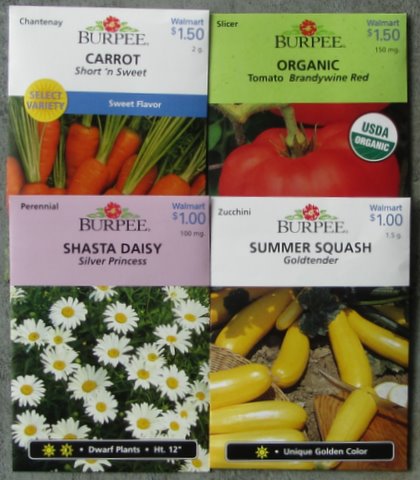
I was pleasantly surprised at the size of the new Burpee display when I stopped by Wal-Mart this morning. I did a rough estimate: more than 400 pockets of seed packets; 60% veggies, about half organic; 25% flowers, both annual and perennial; 15% herbs, both annual and perennial.


Being a tomato fanatic, I usually rate seed racks by the number of tomato varieties offered. The Burpee racks at this store offer: Baxter’s Bush Cherry, Beefsteak and Super Beefsteak, pink and red Brandywine, Cherokee Purple, Delicious, Lunch Mate, Polish Linguisa, Red Lightning, Roma, Snack Attack, Summer Salsa, Super Sweet 100, Yellow Pear, and two mixes—Best of Show and Rainbow Heirlooms. That’s nearly double the varieties offered last year.


Price: about half the packets are $1.00 each, the other half $1.50, including most of the organic selections.


What did I buy?


Brandywine red tomato (organic), $1.50; Goldtender summer squash ($1.00); Short ‘n Sweet carrot, $1.50; Cylindra beet, $1.00; Detroit Dark Red beet (organic), $1.50; and Silver Princess Shasta daisy (perennial), $1.00, a short “pretty” that the deer won’t eat.


That’s all? Well, yes, that’s all I bought at Wal-Mart. The section was excellent for a big-box store but didn’t have all that I’m looking for. Within the next day or two I’ll finalize my online order from Johnny’s Selected Seeds, and I’ll be pretty much set for seeds for Garden Year 2011.


Is there a difference between a packet of veggie seeds bought from the Burpee catalog and a packet bought from a Burpee rack at a local store?


Yes, an obvious difference is price. A packet of Detroit Dark Red beet seeds in the Burpee catalog (and online) costs $3.25, while the packet from the Burpee rack at Wal-Mart costs $1.50. Burpee prices seem to vary from store to store.


Surprise: 469!
I’ve always suspected another difference is the amount of seeds in the packets. The number of seeds in the Burpee catalog beet packet is 350. The Burpee packet at Wal-Mart says 5g, with no number of seeds indicated. Frugal Bob opened and counted each seed, expecting the number to be significantly less than 350. The number: 469. I admit that I was surprised, pleasantly surprised. I had always assumed there were fewer seeds in the lower-priced packet.


Not totally convinced, I went to Burpee online and priced a packet of red Brandywine tomato seeds (organic): $3.95 for 50 seeds. I opened and counted the packet I bought at Wal-Mart, which indicated 150mg. The count: 66 seeds.

 
Ok, I surrender. The lower-priced Burpee packets at Wal-Mart contain just as many seeds, if not more, than their more expensive catalog counterparts. Could Burpee be using inferior seed in the lower-priced packets? Burpee’s name is both famous and trusted in the world of gardeners, so it would be business suicide, it seems to me, for the company to sell seeds of lesser quality in a packet labeled Burpee.


There is another difference I’ve noticed between seed varieties on the racks and those in the catalog. The varieties on the racks seem to be older, better known varieties. The catalog lists many of them too but often features the newest and latest varieties, which may—or may not—be better in some ways than older varieties.


I’ll mention one risk in buying all your Burpee seeds at a neighborhood store. You may eventually be dropped from the Burpee catalog mailing list, though I suspect the trend for most seed companies is to wean their buyers from print to Internet catalogs to help keep down costs.


Now I’ve got to finalize my order for Johnny’s.

Thursday, January 27, 2011

Growing Tomatoes Atop Ice


As I look out the window this morning at 10 inches of snow that fell last night, I have no thought of going out and planting some veggies.

But tomatoes, cukes, and lettuce do grow atop the South Pole ice pack.


Impossible?


No, scientists at the United States South Pole Station grow a variety of veggies and herbs and a flower or two in a remotely controlled greenhouse that the manager calls a “growbot.”


Take three minutes to read Ann Posegate’s “A garden grows at the South Pole,” from Wednesday’s “Kids Post” page of the Washington Post.


To take a fast trip to the growbot, CLICK HERE.

Monday, January 24, 2011

Frugal Gardener: Build a Light Stand


Thinking of buying or building a light stand to start your veggie, herb, or flower seeds this spring, so you can select the varieties you want and save a few bucks in the growing?


How much do you want to spend?  $460.95?  $324.95?  $229.95?  $143.90? $ 60.00?  $17.98?  $9.74?  Nothing?


To check out common possibilities, I paged through what’s probably America’s most popular seed catalog, Burpee. Burpee has a variety of light stands—single and double deckers—available in price from $460.95 to $143.90. All utilize 48” shoplights and include cool-white or wide-spectrum fluorescent bulbs. A Burpee customer for many years, I’ll assume quality is top of the line. Got the $$$ but not time to build your own, go Burpee.


If you want to save some dollars, build your own. A recent weekly email from the Vegetable Gardner website, which is affiliated with Fine Gardening Magazine, included a link to Greg Holdsworth’s article, “DIY PVC Grow Light Stand.” Greg gives a list of what you need and then tells you how to make an adjustable light stand, all illustrated by 12 numbered photographs. He estimates cost of PVC and hardware, including a 48” shop light and bulbs, is $60.00


Want to save even more? All you need is a 48” shoplight and a place in a warm room to hang it. I just checked availability of 48”, 2-light, utility fluorescent shoplights at Lowe’s online and found two available, one at $17.98 and one at $9.74. Of course, you would have to buy two cool-white fluorescent bulbs, which cost just under $7.00. To be fair, let’s add the bulb costs to up the barebones shoplight possibilities to $24.98 and $16.74. Still, those prices are a long, long way from $460.95. Smile, you Frugal Gardener.


And how can you set up your light stand for nothing? Go out in the garage or shop and take down a shoplight and use it for a month or so as your light stand. Or borrow one from a neighbor or friend.


The photo at left shows you how for many years I used two shoplights to start seeds in our utility room, right next to our furnace, where even in these days of cut-back temperature settings, the seed-starting setup stays about 72°F, just a couple of degrees below the optimum temperature for starting tomato seeds. I now use a double-decker light stand that friends gave me a couple of years ago when they were “cleaning house,” but frankly my old shoplight setup on the luggage shelves next to the furnace worked just as well.


To link to the Holdsworth article, “DIY PVC Grow Light Stand,” CLICK HERE.

Wednesday, January 5, 2011

Seed Savers Exchange Catalog: Beautiful Heirlooms


No contest: At Meadow Glenn, the Seed Savers Exchange catalog of heirloom seeds wins the “most beautiful catalog” contest. Take a close look at the cover photo. Beautiful. And then look at the photo of one of the inside pages featuring tomatoes. Beautiful.


Seed Savers Exchange is a not-for-profit, member-supported organization with an 890-acre Heritage Farm near Decorah, Iowa, with display, trial, and preservation gardens. If you do buy seeds, a portion of the price of each packet sold helps underwrite the Exchange’s many educational activities. Warning: You may open this catalog to look for seeds but you may happily detour into sidebars describing the Exchange’s programs, such as its preservation herd of ancient White Park cattle, which originated 2,000 years ago in the British Isles.


New gardeners may want to know what an “heirloom” variety is. Heirloom aficionados might argue, sometimes vigorously, over a definition, but in general it refers to variety that has been handed down by growers for several generations and is open-pollinated. Open-pollinated means that if you save a seed from the heirloom variety and plant it, it will produce the same plant, assuming, of course, that the plant wasn’t cross-pollinated by another variety when it was flowering. Clear as mud?


Page 3 of the catalog contains an index of contents, from arugula, bean, and beet to transplants, turnip, and watermelon. Some of the larger sections are bean (6 pages), lettuce (4), pepper (6), squash (4), tomato (8), and flowers (9). About 200 of the 600 catalog varieties are certified organic.


One danger of reading the catalog descriptions is that you might become so intrigued by new information that you begin reading just for the fun of it. That happened one time when I got hooked by the description of Red Fig tomato: “Philadelphia heirloom documented to 1805…. Used as a substitute for figs years ago by gardeners who would pack away crates of dried tomatoes for winter use.”


Price of a sample seed order: Packet (100 seeds), Detroit Dark Red beet, $2.75. Packet (50), Italian Heirloom tomato, $2.75. Packet (250), Jolly Jester marigold. Shipping: $6.00. Total: $14.25.


Confession: I’m a member, but you needn’t be a member to buy seeds or transplants or to receive a catalog.


To go to the Seed Savers Exchange website, CLICK HERE. You can request a print catalog on the home page.

Vegetable seeds