Showing posts with label DeerCountry. Show all posts

Sunday, April 20, 2014

I love Erica!

Winter-blooming Erica


Yes, I love Erica and was shocked when I found her dead in our garden this spring after our frigid winter—when nighttime temperatures in early January approached zero degrees Fahrenheit.

I love Erica x darleyensis ‘Mediterranean Pink’, sometimes called heather, for two reasons.  First, it’s the only plant that blooms through the winter in our gardens, usually from October into May.  I love finding Erica’s pink flowers poking through a crust of snow.  And second, our local bambits here in Deer Country don’t browse on Erica.

But the “dead of winter” 2013-2014 left our mature Erica dead indeed.  Just days after I had cut back its brittle, dry branches and dug up its roots in late March, I found and bought a new Erica at our local Lowe’s Home Improvement store.  Within hours I had planted the new Erica where we can admire it for many winters to come.  It’s still in bloom, and when the temperatures rise into the 50s, bumblebees already have come to sip nectar.

I love winter-flowering Erica.  The deer don’t.  Long live Erica.
Freeze-killed Erica, guarded by Teddy
Long live our new Erica!


Monday, March 17, 2014

St. Paddy’s Day Snow Visitors

Nosing for red-hot poker leaves

 St. Paddy’s Day 2014 snowstorm left us with about nine inches of snow—and some unusual visitors to our bird feeders.  With the extra snow and ice cover we’ve had this winter, I think I now know why I uncharacteristically bought 80 pounds of sunflower seeds last fall, rather than the usual 40.

Cleaning up sunflower-seed shells

Bird feeders, of course, are for birds—and we see lots of them. Typical birds scrounging for seeds under our feeders are white-throated sparrows, song sparrows, juncos, and cardinals.  Chickadees, titmice, white-breasted nuthatches, and downy and red-breasted woodpeckers feed at the suet and seed feeders.


St. Paddy’s Day snow, however, brought several new visitors.  One was a rufous-sided towhee that was ground feeding with several juncos and white-throated sparrows.  Then arrived three deer, which normally don’t come so close to our house during daylight hours.
Towhee deer-watching
But the deer apparently were desperate for food—any kind of food.  One doe pushed her nose through the snow and pulled out several dead red-hot poker leaves, which normally deer don’t browse because the leaves are so tough and stringy.  And then the three all but inhaled sunflower-seed shells discarded by birds, while the towhee watched from a kousa dogwood tree.

Nearby a garden gnome, with green jacket and, hopefully, insulated underwear, poked his head through the snow to deliver a “Happy St. Paddy’s Day” greeting.
"Happy St. Paddy's Day!"

Wednesday, June 6, 2012

Deer Country: How Cute, But What Will It Eat?


How cute—a fawn napping in a sunspot in our woods!

Two springs ago I surprised a spotted fawn—or did it surprise me?—as it drank from our spring-fed stream.  I was armed with tree trimmings destined for our woodland compost pile, and that fawn vanished before I returned with my camera.

Last year I remembered to look for a fawn and walked through our woods one early June morning—but didn’t find one.

The last few days I’ve noticed a doe grazing on the lawn near our creek early in the morning and late in the evening.  When I saw her again this morning, I decided to do a slow, methodical look in our woods for a fawn.

I was about to admit failure when white spots on chestnut-colored fur in a sunspot near a fallen tree caught my eye.  I stopped and and smiled—a napping fawn—several weeks old, I calculated, and likely following its mother’s order to keep still until she came back with lunch. 

I retreated to the house to fetch Ellen and my camera.  When we got back to the creek, we paused on the east side while I took a “distant shot” or two.  Then like kids—well, sort of—we hopped from stone to stone to cross the sparkling stream.

Just 10 feet or so from the fawn we paused in silence.  The fawn still napped on its leafy bed, curled like a spotted puppy on a rug by a kitchen door.  I took several more photos before we walked on through the garlic mustard and oriental bittersweet, across our culvert, and up the hill to our home. 

“What will that fawn be eating this time next year?”  I thought.  Pansies, heucheras, and hostas?  Tomato, strawberry, and blackberry leaves?  Sunflowers and green beans?  Chard and beet leaves and lettuce?

Sleep on, babe.  I’ll tend my fences and spray my sprays.  But mind your manners when you switch from mother’s milk to summer salad and don’t jump the fence into our veggie garden.  And remember to avoid mint-smelling greens, especially the ones I’ve sprayed. 

Saturday, May 5, 2012

Fragrance: Dianthus and Don

Dianthus & Don


This evening was designed for sitting on the front-porch glider, shelling peanuts as the temperature eased toward 70 and a gentle breeze rustled through the purple-leaf plum trees that cast shadows longer than the trees are tall.

Straight ahead of me two flowering kousa dogwoods framed a birdless bluebird box because this year a pair built their nest in the “white box” in the backyard and already have three blue eggs there.  Nearer me the first dark-blue Siberian iris blooms, a gift of Cindy S., a Howard County Master Gardener.

To my right, in, hopefully, a deer-proof fortress of iron stakes and welded wire, pink rhododendron blossoms proclaim, “This is our best weekend,” as lavender azalea petals loosen and float to the pine-bark mulch.  Nearby a Knockout rose lofts buds that promise future visual delight, and lingering bleeding-heart flowers bob in the freeze.

'Our best weekend'
To my left, bright-blue delicate brunnera flowers and miniature yellow trumpets of corydalis—gifts of Pat H., another Master Gardener, say, “Enjoy every day of May,” while pink, blue, and purple columbine flowers arch over their leaves—gifts of Pennsylvania cousins Curt and Jean W.

A high-school teacher once defined a “weed” as a flower growing where someone doesn’t want it to grow.  I don’t have any weeds.  I let flowers grow wherever they wish—usually—and, of course, as long as they aren’t real weeds.  I hate to uproot them with my hoe or Cape Cod weeder.  I prefer to let them grow—or share them with fellow gardeners.

As the wind shifted slightly on this May evening, a fragrance surrounded me.  I inhaled deeply. It was sweet and spicy.  It was from the patches of dianthus hunkering by our hardy ground orchids, a deer-resistant perennial recommended by Irene M., another Master Gardener.  I wondered how such small dianthus flowers can perfume such a wide area.

My mind wondered to two friends, Don and Joyce O.  Ellen and I have known them for half a century.

Sometimes a flower says it all
You know that kind of friends ...  classmates at high school or college … young families with children about the same ages … later, as empty nesters, chatting over dinner at Sierra’s Grill or enjoying plays at Olney Theatre or concerts at Wolf Trap or Strathmore Music Center. 

For years Don raised black raspberries in their back yard and prepared a quart of “concentrate” each summer that I made into a gallon of black-raspberry ice cream for late-summer gatherings of friends.

A month or so ago Don, a rose grower, was diagnosed with a rare autoimmune disease.  With our tears on Friday we mourned his passing.

I sat on our porch and inhaled the fragrance of the dianthus, but that spicy sweetness was overpowered by an even greater fragrance—memories of Don, husband of Joyce, father of Don Jr., Allison, and Karen, grandfather of four, noted scientist, our friend.

Wednesday, April 4, 2012

Deer Country: Putting Our Hostas on the ‘Pill’

Will these tablets keep
deer away from our hostas?


I started my 2012 deer repellent test yesterday by putting our hostas on the “pill,” the new Repellex Systemic tablet for plants that claims to repel all sorts of critters—deer, rabbits, moles, voles, gophers, groundhogs, feral hogs, cats, and dogs.

The directions on the label seem simple enough: For a small plant, use one tablet for every foot of the plant’s height and width.  I used two tablets for each of two large clumps of hostas and one tablet for each of two small clumps of hostas.  A large clump of hostas about 12 feet away will be my untreated control.  As directed, I pushed each dime-size tablet an inch or more below the soil surface “2-3 inches away from the root crown.”  I then watered the plants to activate the tablets.

You may recall that last year I experimented with mint-based Deer Out repellent spray, and our local bambits ignored our hostas all summer.  When I used the spray, I could easily see that I had hit all major parts of each hosta and had no question about whether I had applied it correctly.

Will a dime-size tablet work the whole summer?
I didn’t get that same feeling of certainty when I “positioned” the Repellex Systemic tablets.  Just where is the “crown” of a clump of hostas?  To measure a hosta clump’s height, do I measure just leaves—or do you include the towering flower stalk?  Will two tablets be enough for the tangled mass of roots of a hosta clump to take up and infuse all the leaves sufficiently to make them deer repellent?

Questions, questions, questions.

I’ll report back occasionally with, hopefully, some answers, answers, answers.

If you missed my earlier posting about the new Repellex Systemic tablets and how they work, CLICK HERE.

If you want to see my final posting about Deer Out, the mint-based repellent spray, CLICK HERE.

Tuesday, March 20, 2012

Deer Country: Rutgers Online List of Resistant Plants

Part of a page of the Rutgers
online list of deer-resistant landscape plants


Has your spring fever reached the level that you’re tempted to drive to the nearest nursery and load your car with plants to fill your landscape—but you’re holding back just a bit because you know the local deer will get more nourishment from eating those plants than you will get enjoyment from viewing them?

I have some great news for you. The Rutgers New Jersey Agricultural Experiment Station (NJAES) Cooperative Extension—yes, that’s really the name—has an online publication, “Landscape Plants Rated by Deer Resistance,” that I think you’re going to value.

This is not the typical deer-resistant plant list that you have to page back and forth through different categories and resistance levels.   For each plant, the Rutgers list gives Common Name, Latin Name, Type (such as Annuals, Perennials, Shrubs, or Trees) and Rating (A, B, C, or D).  For easy reference, the ratings are color coded.  Green A means “Rarely Damaged.”  Yellow B indicates “Seldom Severely Damaged.”  Orange C means “Occasionally Severely Damaged.”  Red D all but shouts, “Frequently Severely Damaged,” don’t plant!

The color coding makes the list easy to use.  You can skim down the list and spot “red” plants if you want to fatten up your local deer herd or “green” ones if you want to slim them down.

After the Common Name of some of the plants appears a small icon of a camera.  Click on the camera and you’ll see a photo of that plant.  If you want to go from there back to the list of plants, click on the white X in the small circle at the top right-hand corner of the photo.  If you click on your return arrow, you’ll likely go back to where you were before you surfed to this site.

And there’s more.  This site lets you “Browse” or “Search.”

Let’s do “Search,” the simpler one, first.  Just type in a common or Latin name and click “Search,” and presto, there’s a list in glowing colors.  For example, I typed in “holly” and a list appeared with 16 holly varieties.  First was a green line with “American Holly,” “Ilex opaca,” “Trees,” “Rating A” (“Rarely Damaged”).  Last was a yellow line with Wintergreen Holly, Ilex verticillata, Shrubs, Rating B” (“Seldom Severely Damaged”).  And mid-list appeared an orange line with “Hollyhock,” “Alcea sp.,” “Perennials,” “Rating C” (“Occasionally Severely Damaged”).

I suppose most gardeners thinking “landscape” and “holly” are fantasizing about a tree or shrub, but the reality is that a computer runs this list and when you enter “holly,” the computer lists any plant on the list that contains h-o-l-l-y.

The “Browse” function adds to the excitement.  You can select any Rating category (All, or A, B, C, or D), any plant type (All, Annuals, Perennials, Bulbs, Ferns, Groundcovers, Ornamental Grasses, Shrubs, Trees, or Vines), and Sort them for delivery by “Common Name” or “Latin Name.”

Interested in common names of shrubs that deer “Frequently Severely Damage” so you replace your landscape every year?  Here’s your list: Evergreen Azaleas, Pinxterbloom Azaleas, Rhododendrons, Wintercreeper, and Yews.

Is the Rutgers list perfect?  Nothing in Deer Country is perfect, not even the Ancient Gardener.  Deer don’t read lists of resistant plants so just might ignore a red-coded plant or chow down on a green-coded plant.  Arrowwood viburnum is green-coded on the list but bambits here at Meadow Glenn browse our two specimens so heavily that I have caged them so we can enjoy more than leafless branches.  And then there’s the misspelled “Pampus Grass,” which I hope does not refer to “Pampas Grass” with an infected cell.

Minor imperfections aside, I recommend you add “Landscape Plants Rated by Deer Resistance” to your Favorite sites for future reference—and for sharing when a neighbor asks you about plants that deer don’t eat.

To go to the Rutgers site, CLICK HERE.

Sunday, March 11, 2012

Deer Country: Butterfly Bushes and Flurries

Time to prune butterfly bushes
I gave our three butterfly bushes (Buddleia davidii ‘Pink Delight’), one of the shrub species our local bambits have never nibbled, let alone browsed, their annual pruning on Tuesday.

Cutting back butterfly bushes is important because they bloom only on growth of the current year.  They are fast growers, so cutting them to one foot or so means that this year’s blooms will be close to eye level and they won’t crowd nearby plants.

In his “Manual of Woody Landscape Plants,” Michael A. Dirr says of Buddleia davidii, “[I]n many respects better pruned to the ground in spring since it flowers on new growth of the season; … even the compact types like the Nanho series reach 6 to 8’ … high unless restrained; in the Dirr garden, butterfly-bushes receive lots of play, on occasion plants were pruned to 12 to 18” of the ground, at other times untouched with only a tip prune here and there; … unpruned plants produce flowers sooner in the growing season than heavily pruned plants.”  And, later: “Attracts an amazing array of butterflies and bees.”

Showing their age, but aren't we all?
If our three butterfly bushes were located in a less congested part of our landscape, I might experiment with pruning them to varying heights to see if they would flower at different levels and times.

Our three plants are showing their age—but aren’t we all?  I planted them in 1998.  Now their main stems are gnarled and show signs of dieback.  In another year or so I probably should replace them.

Early Tuesday the temperature was 28°F.  When I began pruning it was 44°.  Then the overcast day darkened, a breeze picked up from the north, and the temperature dropped noticeably.  As folks in south Jersey would say, “Suddenly it felt raw.”  And then snow flurries began.

I stacked my prunings and will cart them to our woodside compost heap on a nicer day—perhaps one of those 60° or 70° days forecast for later in the week. 

As the old saying goes, “If you don’t like the weather, just stick around for a few minutes.”
A well-named shrub

Wednesday, March 7, 2012

Deer Country: Disappearing Crocuses

Crocuses on Monday


The deep purple crocuses caught my attention Monday.  The day was cloudy—we had a few flurries—so the crocuses sulked a bit and didn’t open, as the first photo shows. 

When I went out sunny Tuesday morning to do some late-winter cleanup of that bed, I thought the crocuses would welcome me with open petals.

Alas, our local deer had struck overnight and browsed the crocuses to the ground, as you can see in the lower-right corner of the second photo.  But if you look again at the second photo, you’ll see some yellow in the background—daffodils in full bloom—unbrowsed by our local bambits.

Tuesday's crocus stubs at bottom right
For springtime blooms in Deer Country, think daffodils, which deer normally shun.  To invite deer to a banquet, think crocuses and tulips, deer favorites that, along with hostas and pansies, sometimes are called “deer candy.”

I didn’t get to enjoy our purple crocuses this year, but I did walk around the front yard and cut a handful of daffodils to take into the house.  Ellen was at her quilt-guild meeting, so I put the daffodils in a simple vase and put it on the kitchen table.

Would she notice?

A couple of hours later, she came home.  As she walked into the kitchen, she looked at the vase of yellow flowers and said, “Oh, daffodils.  They’re beautiful.”

Beautiful.

Will she notice them?

Saturday, February 25, 2012

Deer Country: Why Deer Don’t Eat Ornamental Grasses

Fountain grass in summer
In my recent posting, “Deer Country: Bib Jeans, New Trimmer, 26 Flat Tops” [Feb. 15], I commented, “Best of all, deer don’t eat fountain grass—and most other ornamental grasses.  I suppose the reason is that the grass is too tough for them to easily bite off and then chew.”

Bettye Ames, a Howard County Master Gardener, emailed me a more enlightened reason why deer don’t eat ornamental grasses:  “The stems and leaves of ornamental grasses contain silica (read ‘glass’), which can cut the mouths of grazers.  This same silica may cut our dear gardening hands and arms if we forget to put on gloves and long sleeves while cutting our ornamental grasses.”

I knew ornamental grasses can be tough.  I knew my old electric trimmer sometimes mangled tough fountain-grass rather than cutting it cleanly.  I knew it was easier to cut stems than to pull them off.  But I didn’t know about the silica.

An Internet search quickly confirmed Bettye’s explanation.  Both Wikipedia and Pediaview contain identical sentences: “The leaf blades of many grasses are hardened with silica phytoliths, which helps discourage grazing animals. In some grasses (such as sword grass), this makes the edges of the grass blades sharp enough to cut human skin.”

Fountain grass in fall
Another website mentioned that some grasses contain sufficient amounts of silica to dull cutting blades.  Several sites used bamboo as an example of a grass containing so much silica that its stems are rigid.

As I read, I involuntary shuddered, and hair on the back of my head stood up.  I remembered visiting Hugo, a school mate, about 65 years ago.  We thought it was fun to explore the remains of the nearby, abandoned slaughter house that had burned several years earlier.  At some point we explored a nearby patch of tall grass and thought we would pull enough to make a hiding place.  I grabbed a handful of grass and pulled, and as it slid between my right palm and index finger, I felt the grass slice through my flesh.

I screamed and, dripping blood, ran to Hugo’s house.  I don’t remember all the details today, but I do remember someone holding my bloody hand under a gushing stream of cold water as someone else pumped vigorously.  Soon the bleeding stopped and my wound was taped shut.  A faint scar by the second joint on the inside of my index finger reminds me of that day.  I suppose the old pump at Hugo’s house has long since disappeared and the site remains undesignated as a national historic site, despite the blood shed there.

Thank you, Bettye, for widening our knowledge about ornamental grasses and why deer usually avoid them and for the reminder to wear gloves when we work with the tough ornamental grasses.

Tuesday, February 21, 2012

Deer Country: Freeing our trees

Buck rubbing tree with 24" protector
(galvanized hardware cloth)
I’ve been freeing many of our young trees when weather permits, which has been frequently this balmy winter.  Readers of this blog know that deer abound at Meadow Glenn and to grow trees requires that I cage them in their early years with metal stakes and welded wire.

I make the cages with two iron fence posts and a circle of 36”-wide welded wire that’s about two feet in diameter.

Many of the trees I’ve planted over the last six years were four- to five-feet tall, so most of their leaves were at a perfect height for deer browsing.  That’s why I began building cages—to separate leaves of young trees from mouths of hungry bambits.

As the trees have grown, I‘ve pruned their lower limbs so the lowest now are above the “browse line,” the imaginary line about five feet from the ground above which deer seldom browse.  It’s time to remove the cages, which, frankly, as landscape accents never will be featured in Fine Gardening magazine. 

Sumac that snapped
when buck rubbed it
Though browsing deer are no longer a major problem, rubbing deer are.  Rubbing deer are bucks in the fall—generally October or November—that wants to rub off the dead velvet that covered their growing antlers and then to polish their new racks.  Bucks prefer young, springy trees and shrubs for that purpose and generally rub vigorously about a foot or two from the ground.  Points of their antlers can damage the trees, even kill them if the rubbing severely damages the bark around the whole tree trunk.

Bucks here at Meadow Glenn seem to prefer to rub trunks up to two inches in diameter.  Local favorites are sumac, maple, and oak.  Small maples and oaks usually are tough enough to survive most damage, but sumacs often snap a few inches from the ground. 

Because of the rubbing problem, when I remove cages from our trees, I still must protect their trunks.  After trying a variety of trunk-protecting materials—including 24-inch galvanized hardware cloth and 36-inch welded wire (2”x3” grid)—I’ve settled on 36-inch plastic hardware cloth (1/2” grid).  The plastic hardware cloth is easier to cut with wire cutters and to handle, and bucks often adjusted to the 24-inch size by rubbing just above it.

Plastic hardware cloth
and bag of cable ties
I cut the 36-inch plastic hardware cloth in lengths that make a circle that’s between four and five inches in diameter, which leaves room for the trunks to grow for several years.  I secure each protector in place with two eight-inch cable ties, one about six inches from each end of the protector once I’ve wrapped it around a tree.

I haven’t found rigid trunk protectors locally, but several varieties are available on the Internet.  Search: “tree trunk protectors.”  Some are short to protect bark from string trimmers.  Others range up to four feet in height.

I checked prices today at Home Depot to see what the raw materials currently cost.  A 15-foot roll of 36-inch “Black Plastic Hardware Cloth” (1/2-inch mesh) sells for $16.44.  A bag of 100 eight-inch black cable ties costs $5.99.  A roll that long would make 13 protectors four inches in diameter.  Cost would be just over $1.30 for each protector and two ties.  That’s about a $5.00 saving on each from Internet prices (plus shipping) of comparable products. 

Do I hear a Frugal Gardener shouting, “Yes!  I can save a few bucks— some serious dough—if I make my own!”

Plastic protectors in place
in Deer Country
Deer Country puns aside, I’ve already removed cages from more than 20 young native trees that I’ve planted since 2006—red maples, tulip poplars, American dogwoods, American redbuds, and black gums.  Maybe in another five years I’ll be able to remove the trunk protectors too.

That’s all the excitement I can report from Meadow Glenn, where I cage the trees and the deer run free.

Wednesday, February 15, 2012

Deer Country: Bib Jeans, New Trimmer, 26 Flat Tops

Fountain grass needs cutting back
What a beautiful February day—bright sunshine, temperature hovering just below 50°F, slight breeze.  I put on my new pair of bib jeans, unboxed my new 17” electric hedge trimmer, grabbed a 100’ extension cord and a pitchfork, and went to work cutting back our perennial fountain grass.

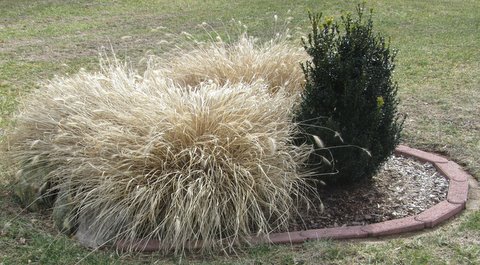
Fountain grass (Pennisetum alopecuroides) is a great landscape plant for Deer Country.  It has character—bright green in spring and early summer, grows nearly 3’ tall, is light golden brown in fall, and attracts birds that seem to savor its seeds well into winter.

Best of all, deer don’t eat fountain grass—and most other ornamental grasses.  I suppose the reason is that the grass is too tough for them to easily bite off and then chew.

We have 26 clumps of fountain grass.  Four in a front yard island bed help another deer unfavorite, boxwood (Buxus x ‘Green Mountain’), hide the vent of our septic system.  The remainder are in our backyard, most on the outside of our fence where they help dissuade local nimble bambits from jumping the 4’ split rail and wire fence by widening the jumping obstacle.

Without the fountain grass, the fence is about six inches wide.  With the fountain grass, the hurdle, at least from a deer perspective, is about five feet wide, a width our bambits so far have refused to jump.

Fountain grass with flat-top cuts
Every February or early March, though, before the fountain grass begins its spring growth, I cut back the previous year’s grass.  I call it giving the clumps their annual flat-top haircuts.

That’s what I did this morning.  The job took less than two hours, including stacking the cuttings with my pitchfork for easy moving to our compost heap when my Kubota tractor returns from its annual winter service appointment.

Oh, my Aching Back, I thought, as I finished bending and cutting and stacking.  Yes, my back ached—and also my left ankle and knee and right shoulder.   Why don’t young gardeners ache, I often ask?  Do pains of age only begin at three score and ten?

And then, as I looked at the stack of hay I’d piled on the side of the hill and felt the warming winter sun soothing my aching muscles and joints, I thought of the ancient nursery rhyme, at least as best as I could recollect:

Ancient Gardener Blue,
Come raise an alarm,
The squirrel’s on the birdfeeder,
The deer are eating the corn.
Where is that gardener
Who keeps away the deer?
On the haystack
Fast asleep!
Will you wake him?
Oh no, not I!


And guess what I did right then and there—as warming winter sun soothed my aches and pains?
Yes, I really did

Thursday, December 15, 2011

Deer Country: What’s Blooming Mid-December?

Heather, the perfect winter flower for Deer Country


Yes, it’s mid-December, we’ve had multiple killing frosts, so our gardens must be dormant—right?
Wrong!  When I walk around our gardens doing winter chores—mostly cleanup and preparation for the next growing year—I see lots of flowers here and a few there.

The “lots of flowers here” is our heather shrub (Erica spp.), after six years about two feet high and five feet across.  Deer don’t browse this tough shrub, which is why it’s in our front yard and unprotected by wire cage or a deer-repellent spray.  The heather started blooming in mid-November and will bloom through the winter and into May.  How nice to pause and admire delicate pink flowers while I’m shoveling snow.

Moss phlox in its cage
Just a few feet from the heather are two kinds of pink blooms—several on moss phlox (Phlox subulata) protected by the wire tent I described in an earlier posting—and a lone dianthus (Dianthus spp.) blossom.  Across the sidewalk, a red Knockout rose (Rosa arbustiva ‘Double Knock Out’) sways gently in the December breeze above its wire cage.  How many more hard frosts can these three survive?

Just around the corner of the garage, a forsythia (Forsythia x intermedia)—probably encouraged by the extra warm fall—sports 10 or so flowers.  A week ago there were more than 20 flowers, so frosty nights are taking a toll.

Dianthus
And about midway between the forsythia and the heather, a weed, common groundsel (Senecio vulgaris), snubs frosty temperatures with green leaves and yellow flowers.  My “weed book,” Weeds of the Northeast (by Uva, Neal, & DiTomaso), warns that groundsel “contains pyrrolizidine alkaloids that cause liver damage in horses and cattle.  Small herbivores, such as sheep, rabbits, and goats are resistant to the toxic effect….”

And humans?  I’m not about to experiment, and perhaps there’s a reason the bambits haven’t sampled the groundsel.   

In addition to groundsel’s toxicity, there’s another reason I must trash this flowering weed.  The weed book notes that “open flowers can develop fully mature seed after plants have been killed by cultivation or herbicides.” Whoa!  Groundsel certainly rates a plastic bag in this gardener’s trash can.

Knockout rose
As days become short, shorter, and shortest in December, I tend to stay indoors more and overlook what’s happening in our garden.  But when I go outside and take a minute to look around, I usually can find some flourishing plant—perhaps even a bloom—to add a positive note to a frigid day.


Forsythia

Groundsel

Monday, December 12, 2011

Deer Country: Don’t Cut Back Perennials?

My surprise--a browsed lychnis plant
I took my pruners to one of our perennial beds to cut back the dead flower stalks of our rose campion (Lychnis spp.) and discovered something that convinced me to put my pruners away.

One of the younger lychnis plants had been deer browsed.  That was significant here at Meadow Glenn because I’ve never seen a browsed lychnis plant in the four years they’ve been growing in that bed.  Photo 1 clearly shows the browsed leaves—some with tough fibers still attesting to a tough, fuzzy meal attempted by a deer.

Just a foot way another lychnis plant lay unbrowsed under a protective umbrella of dead stalks (Photo 2).

Unbrowsed lychnis protected by dead stalks
Eureka—a thought!  Perhaps deer are as energetic as I am and take the easy way out if they have a choice.  Exposed leaves: browse.  Protected leaves: pass by.

I looked around.  Not far way was a Shasta daisy with tall but dead stalks.  Still-green leaves of the plant hugged the ground.  A couple of the outer, unprotected leaves had been browsed—but the leaves protected by the stalks were untouched.

Put the pruners away until late winter, Bob.  Let the dead stalks help protect the plants over winter.  Sounds like a good plan to me.

And there are other reasons not to cut back dead perennial seed stalks.  Seed-eating birds—chipping sparrows and song sparrows, for example—check them out for winter food, and the stalks add character to gardenscapes when frosted or coated with ice or snow.

Seed stalks add winter character
Ah, yes, these are excellent reasons to put away my pruners until some sunny, pre-spring day in February.  Meanwhile, back at my lounger….

Monday, December 5, 2011

Deer Country: New Fort Guards Our Viburnums

Strike 1: Wire cage was too small & deer
browsed every leaf that grew through the grid
Several years ago I built a protective cage of iron stakes and plastic deer fencing around four viburnums, two Blue Muffin arrowwood (V. dentatum) and two Cardinal Candy (V. dilatatum), after our local deer had heavily browsed them three times in one growing year.  The heavy browsing was taking its toll, and I feared the shrubs would die.

The new cage worked for a year or two, but late last year a deer discovered that if she leaned against the plastic fencing, it would give, and if she leaned far enough, the iron stakes would bend at ground level and she would have access to browse the two closest shrubs, the arrowwoods.  This year deer further collapsed the plastic fencing, entered the cage, and heavily browsed all four shrubs.

Last week I created Fort Viburnum around the four shrubs.  I used 5’ iron stakes every four feet and attached 3”x2”, 16 gauge, 36” galvanized wire fencing that advised on the label, “Ideal for garden enclosures.”  The final cage is about 20 feet long and stands about four feet from the center of the shrubs.  The fencing tops out at 4 feet, with a 1-foot gap between the ground and the bottom of the fencing.

Strike 2: Deer leaned into
plastic fencing and collapse the whole fence
I haven’t the slightest doubt the “ideal for garden enclosures” fencing will keep the viburnums in, but will it keep the deer out and permit our shrubs to flourish?

 Most mature deer could stand by a 48” fence and with ease gracefully jump over, but I’m counting on several factors that deer-management books and magazine articles often mention. 

First, the “cage” at most is about eight feet wide, and deer often seem reluctant to enter small spaces in which easy exit may be uncertain. 

Second, I’ve laid 6”x18” red patio blocks all the way around the cage to add another uncertain element to inquisitive deer.  The blocks also will help keep mulch inside the cage and create a distinct border that will speed lawn mowing.  I also hope the blocks will discourage deer from trying to slip under the fence. 

Third, I’m not going to let other plants, other than an older red maple tree, grow inside the fort and tempt the deer to find a way inside.  I’ll keep it mulched but will not add or permit any “deer candy”--hostas or tulips or local weed favorites such as poke, violets, and white clover.

Will the new Fort Viburnum's iron stakes & wire fencing
be Strike 3?
Of course, some buck next fall may decide to use the iron stakes to rub velvet off his antlers or to polish them—as a buck did a month ago with several stakes of nearby Fort Kevin, which protects our redosier dogwoods.

After I originally planted the viburnums and they were heavily browsed and rubbed, I built small wire cages around each of the plants.  That was Strike One because deer nibbled every leaf that grew through the wire.  Strike Two was the cage that I just replaced—iron stakes with plastic deer fencing, which the deer ultimately pushed over and then entered to browse. If deer do breech Fort Viburnum, I’ll consider that Strike Three and most likely abandon the shrubs to the bambits.

Over five years the cost of the materials for the three kinds of cages I’ve built to protect the viburnums probably exceeds the cost of the shrubs.  Another cost that I must consider is that of “age.”  I’m five years older than when I first started making cages to protect these plants from the deer, and each year it’s harder for me to drive in iron stakes, unroll and cut and install wire, and handle patio blocks, which each year seem to weigh heavier.  Oh, my Aching Back!

So, bambits—and that includes the 11 that watched as I built the new cage—have mercy on our four viburnums and the Ancient Gardener.  Gaze and browse outside Fort Viburnum, not inside.

To see how a buck damaged iron stakes of Fort Kevin, CLICK HERE.

Deer Country: Deer of a Feather…

Her snack...


Beth, a Howard County Master Gardener, puts out sunflower seeds for the birds—and a few neighborhood deer that dine on the high-quality seeds.

His snack...

“I buy black-oil sunflower seeds in 50-pound bags and we go through one in two to three weeks.  I also have a feeder with thistle seed and had one with suet, until it fell last winter and disappeared. I put sunflower seeds in the feeder in the photo plus two other feeders and in a pile on a stump in the adjacent woods, which is part of a tree conservation area we share with our neighbors. It hosts many animals and I'm happy to feed them seeds. I just wish they would stay away from the stuff I plant.”


Yes, Beth, that’s the joy of living in Deer Country, where deer love to eat things we plant.


“In any case, I've not put much thought into deterring anyone as everyone has to eat.” Beth continued.  “My only solution for keeping the deer out of the feeder is not to fill it completely as we would be broke from how much seed we would go through!  Instead, I get the camera out and shoot them.”

Their snack...

“This summer three does and four fawns came by occasionally.  I've seen them more often in the late summer and early fall, maybe as often as three or four times a week. I imagine as their food sources get leaner, I'll see them more often. Last winter I believe they even ate the sunflower shells they were so hungry.”


Thank you, Beth, for shooting your deer with your Canon (camera)—and sharing the photographs with Deer Country.


Thank you, Beth

Thursday, December 1, 2011

Deer Country: Deer Cull Controversy

Want a good discussion topic to upset your neighbors?  Tired of politics or religion?  Try the subject of culling neighborhood deer by shooting them.

Today’s Washington Post has an eye-grabbing photo of a stunning white-tail buck jumping a fence over this headline: “Residents divided over deer cull: The USDA plans to thin herd in bayside Maryland community,” by Avis Thomas-Lester.

Residents in Bay Ridge, Maryland, near Annapolis, are confronting “roving deer that devour vegetation and wreak havoc” in their local woods and their civic association’s decision to cull the herd, which is approximately twice the size the local forest can support.

You should read the article because it outlines the basic arguments the two sides of the “kill/don’t kill” controversy.

To read Thomas-Lester’s article, or just to sneak a peek at the fantastic photograph of the buck jumping the fence, CLICK HERE.

Friday, November 25, 2011

Deer Country: Counting Our Bambit Blessings

Three deer...
As Ellen and I put the finishing touches on the post-Thanksgiving cleanup on Friday, I glanced out the sunroom windows and noticed several groups of deer.  To get an accurate count, I went outside and walked around the house.  A herd of 19 grazed in the field to our south.  Smaller groups grazed to the west and north—a total of 26.  All were does and young.

But White Flag—the doe with the damaged tail that always stands straight up—and her two fawns weren’t there.  Neither were the bucks—Big Buck 2011, the medium twin bucks, the small twin bucks, or the disabled young buck with the shattered front-right knee.    Alas, if all the bambits were in sight I would have counted at least 35—a record number here at Meadow Glenn.

Six deer...
As I walked about slowly and took photographs, many of the deer just stood and watched and perked-up their ears, especially when I made a “kissing” noise with my lips.  Their perky ears are the equivalent, perhaps, to the smiles we humans make when a photographer instructs, “Say cheese.”

With so many deer browsing 24/7 in our neighborhood, when snow and ice cover much of their wintertime food supply this winter, will hunger urge them to break through the cages of iron stakes and welded wire I’ve installed and to browse the buds that would be next spring’s leaves and flowers?

Nineteen deer
Some long-range forecasts say winter will be “about average.”  Perhaps our deer will have sufficient food without our azaleas and viburnums.  But perhaps we’ll have a hard winter and lots of deer-damaged shrubs and trees.

I'm hoping for a “good” winter during which our beautiful bambits will find enough food outside our landscape to satisfy their hunger.  When I walk about and take their pictures, I consider them a blessing.  But when I see browsed shrubs and trees in the spring, I have other thoughts.

Sunday, November 20, 2011

Deer Country: Protective Cages for Shrubs

New PVC/netting cage for azalea
I planted three azaleas more than 10 years ago.  The two I protected from deer browsing with iron stakes and wire fencing are about six feet tall and each spring are covered with lavender flowers.  Because of deer browsing the flower buds in late winter, the unprotected plant is about 18 inches tall and each spring has few flowers.  When I recently saw a doe nibbling on the short azalea’s “backside”—the side from which the deer usually approach during the day—I decided it was time to build a protective cage.

Photo 1 shows the new cage, which I built from three 10-foot, 1½-inch PVC pipes, four 90° elbow joints, and one T-joint.  Since the azalea I want to protect is about 18 inches tall in most places but sprawls about four feet, I cut two 5-foot pieces from one of the pipes for the horizontal supports (the tops).  For the vertical supports (or legs), I cut five equal pieces (3 feet, 4 inches each) from the two remaining pipes, leaving a sixth piece for a future project.  The longer legs will give the plant room to grow.

Deer discovers new cage
I assembled this slightly more complicated structure basically the same way as I did the shorter structure I described in an earlier posting.  I used the elbow-joints to connect the ends of the tops to the legs.  I cut one top in half and joined the two pieces with the T-joint, with the fifth leg underneath.  I installed the 3-leg piece below the 2-leg piece to support help support both pieces and tied everything together with nylon string.  I hammered a 36-inch garden stake into the ground to help keep each leg in place.  I then wrapped the cage in deer netting, hoping that it will be sufficient to deter wintertime browsing.  If that doesn’t work, next winter I’ll add 2”x3” welded wire, which I used for the shorter cage.

Does the new cage work?  Photos 2 and 3 show a deer discovering the new arrival—the cage—around the azalea.  I happened to glance out a front window and saw deer moving toward our flower beds as they grazed.  I grabbed my camera and watched with a smile as one deer noticed the new structure.  The deer first surveyed the new cage from behind a Russian sage—looking intensely, sniffing, focusing its ears, like “radars,” on the contraption.  It took a few additional, cautious steps toward the cage, again looking, sniffing, listening.

Deer trying to figure out new cage
Oh how I wished the cage could have shouted, “Boo!”  But that wasn’t necessary, because after a few seconds, the curious deer turned and ran to rejoin the nearby, grazing herd.

Photo 4 shows a simpler cage I made for a miniature azalea that a friend gave us when my mother died a few years ago.  It has been a late-winter favorite of browsing deer, so each fall I encircle it with fencing that sits on the mulch and is anchored by four garden stakes.  For three winters it’s worked well, and each spring the small azalea has more pink flowers.

If deer browse your flowering shrubs, be creative.  Protect them some way.  The buds you save this winter will be next spring’s flowers.

Simpler cage for smaller azalea
To go to my earlier posting about the shorter PVC/wire cage that protects our moss phlox, CLICK HERE.