Showing posts with label Birds. Show all posts

Monday, March 17, 2014

St. Paddy’s Day Snow Visitors

Nosing for red-hot poker leaves

 St. Paddy’s Day 2014 snowstorm left us with about nine inches of snow—and some unusual visitors to our bird feeders.  With the extra snow and ice cover we’ve had this winter, I think I now know why I uncharacteristically bought 80 pounds of sunflower seeds last fall, rather than the usual 40.

Cleaning up sunflower-seed shells

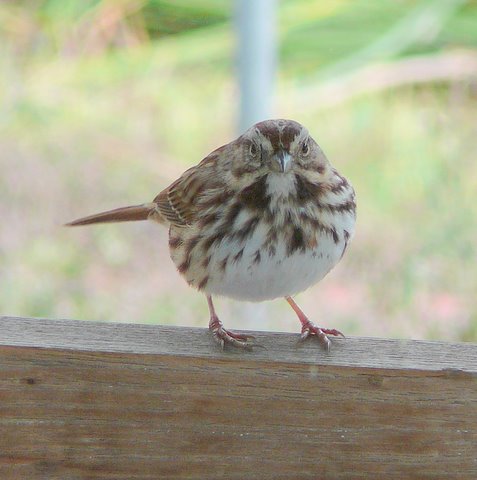
Bird feeders, of course, are for birds—and we see lots of them. Typical birds scrounging for seeds under our feeders are white-throated sparrows, song sparrows, juncos, and cardinals.  Chickadees, titmice, white-breasted nuthatches, and downy and red-breasted woodpeckers feed at the suet and seed feeders.


St. Paddy’s Day snow, however, brought several new visitors.  One was a rufous-sided towhee that was ground feeding with several juncos and white-throated sparrows.  Then arrived three deer, which normally don’t come so close to our house during daylight hours.
Towhee deer-watching
But the deer apparently were desperate for food—any kind of food.  One doe pushed her nose through the snow and pulled out several dead red-hot poker leaves, which normally deer don’t browse because the leaves are so tough and stringy.  And then the three all but inhaled sunflower-seed shells discarded by birds, while the towhee watched from a kousa dogwood tree.

Nearby a garden gnome, with green jacket and, hopefully, insulated underwear, poked his head through the snow to deliver a “Happy St. Paddy’s Day” greeting.
"Happy St. Paddy's Day!"

Thursday, November 3, 2011

Up Go the Bird Feeders

From left, nyjer, sunflower seed, suet feeders


Today I enjoyed a beautiful autumn day by doing one of my favorite fall chores—putting up our bird feeders.  In recent years I’ve tried to hang them by mid-November, but today’s sunny skies and 60°F. temperature beckoned me to “get out the feeders” now. 

The left feeder has nyjer seed, commonly called “thistle,” especially for goldfinches and any of their finch cousins that care to dine.  The center feeder has black-oil sunflower seeds, the favorite of many species.  The right feeder contains suet that is exposed through hardware cloth on the bottom of the feeder.  Woodpeckers, chickadees, titmice, and nuthatches are skilled at eating upside down, but not those suet gluttons the starlings.

I didn’t ring a bell to announce “Chow time,” but the serving line began to form in minutes.  First to arrive were two chickadees and a pair of titmice that started carrying off single sunflower seeds to nearby shrubs and trees to crack and eat.  I’ve also seen one female goldfinch, a male house finch, a junco, a downy woodpecker and—wait—three squirrels!

Squirrels? 

Already the gray critters have shimmied up the galvanized pipes and across the loose PVC pipe I installed to keep the opportunists off balance.  I shooed them twice and then did what I had forgotten to do—to coat the upright pipes with petroleum jelly.  Hey, take that, sticky paws!  And, Bob, remember the petroleum jelly next spring before you grab the poles to take down the feeder support for the summer.

A first responder: titmouse samples suet
I suppose we’ll have lots of warm, sunny fall weather over the next month or so, but I’m happy that the feeders are up and the birds are getting to know that they’ll have a place to grab a snack when the really bad, winter weather sets in.

If you’re thinking of building a feeding station, consider building something like what I’ve made.  I bought 1” galvanized pipe at Home Depot in precut, prethreaded lengths.  The top that holds the feeders has the following lengths and parts: one 36” for the center; two 24” for the ends; plus two T-joints (between center piece and the end pieces, with the support pipes going down) and two elbows and two caps for the ends.  The uprights were probably 10’, but I cut off 12” or so because the contraption was too tall for me to conveniently refill the feeders.  The six pieces of 2” PVC pipe are loose to discourage squirrels.  They also help keep the feeders in position.

Unseen parts:  Below ground are two four-gallon buckets, each with a 18” piece of 2” PVC pipe centered and sticking up and out the top of the bucket several inches and above the mulch several inches.  To keep the PVC pipe in position, I put a half bag of concrete mix in each bucket and made sure the two pipes were plumb when the concrete began to set.  The buckets stay in place year round, and I simply remove the feeders and lift out the support structure for summer storage in our garage.

After exposure to more than 10 winters, the structure has fewer signs of aging than I do, but then I’ve been around for more than 10 winters

Sunday, June 5, 2011

Our Bluebird Quintuplets

Mark gets ready to band
the Nixon quints


There is lots of action at Meadow Glenn these days. Our quintuplets are doing well—eating regularly and rapidly growing both in size and feathers.

Our quints are baby bluebirds. A bluebird pair chose our front-yard bluebird box as their nesting site this spring.  Four weeks ago, Mark Wallace, whom we call “Our Bluebird Guy,” announced that the box contained five light-blue eggs. Then for about two weeks, the parent bluebirds brought insects to their brood of five every few minutes from sunrise to sunset—and occasionally carrying away the bird equivalent of dirty Huggies.

We think Mark is a neighborhood hero. He monitors nesting boxes in Howard County and a few neighborhoods in nearby counties—more than 600 boxes. He visits some of the boxes as many as six to eight times over the nesting season, and he’s been doing it for 40 years.

Why? “It’s just my contribution,” he answered.

Mark checks the condition of the boxes in early spring. When nesting begins, he monitors more closely. His years of experience give him a pretty good idea of when the eggs will hatch and when the young birds will fledge—leave the box on their first flights.

That’s why Mark came on a recent Friday afternoon. He wanted to band the young bluebirds before they fledged, and he was concerned that he might have waited a day or two too long and they might have left.

Mark removed the screw that holds the top on the box, and mounted the five-gallon bucket he carries as his ladder, and looked in.

“I’ll have to be careful. I don’t want to have to chase and catch one that decides to take off now.”

Mark reached in, and brought out a nestling, which he held gently in his left hand. The bird was calm.

“Female,” Mark said, and he attached a numbered band on the bird’s right leg. He put the baby back into the box, to one side, to help him keep track of which birds had been banded.

How does he know females from males? Baby females have much less blue in their feathers.

“Female,” Mark said, as he repeated the process.

One of the three males
“Male,” he said, and the wing feathers of the nestling in his hand were much bluer at the tips.

“Male,” he said again.

“Male,” he said for the last time. Three males, two females—the Nixon Bluebird Quints.

“When do you think they’ll leave?” I queried.

“They could leave today if they wanted,” Mark replied.

Saturday evening the parent bluebirds still were taking food into the box. On Sunday all was quiet. The flights had ended. The nest was empty. But now I hear a delightful sound, the “Cheer, cheer” songs of seven bluebirds. I hope they’re saying, “Let stay here at Meadow Glenn and search the gardens for our favorite insects to eat.”

One day soon Mark will drive his gray Ford pickup down our driveway, park, and walk over to the bluebird box. He’ll open it and clean out the old nest, so the box will be ready for the bluebirds—or another pair—to start building a new nest. Some pairs will nest three times in one year.

Most of the boxes he monitors and the birds he bands are bluebirds, but his nesting list is much longer: tree swallows, chickadees, titmice, nuthatches, even great crested flycatchers and wood ducks.

When Mark finished banding the Nixon Bluebird Quints, he looked at this watch, said he had to leave to go to work in 15 minutes, and walked across the lawn to the box on the fence by the Gabels’ swimming pool.

“Three females, two males—about two days younger than yours,” he said, when he returned to his truck. “Not bad—five females, five males in the two boxes.”

Mark looked at his watch again. “I’ve got to get going.”

Thank you, Mark, Our Bluebird Guy.

Tuesday, May 17, 2011

Have You Killed a Bird Today?

Can I fly through your diningroom?


Thud!

We cringe at that sound, which we occasionally hear at Meadow Glenn. We know exactly what it means: a bird has crashed into one of our windows.

I rush to add that we usually—but not always—discover that the bird is momentarily stunned but in a few minutes regains its senses and flies away. Years of observation have taught us that the most frequent causes of the crashes is that birds at our feeders have been panicked by an approaching hawk.

We might take a simplistic approach and try to figure out “the one cause” of such an accident. I might blame the hawk because if there were no hawk, there wouldn’t have been a panicked flight into the window pane. The victim might blame the house—or the bird feeder. If there were no house, there would be no window to crash into. And if there were no feeder, the victim wouldn’t have been near the window when the hawk came hunting.

The last two “causes,” of course, are related to human activity, which researchers have linked to billions of bird deaths each year in the United States. In his “Urban Jungle” column in the Washington Post, Patterson Clark recently listed six human-related categories and the number of bird deaths associated with each.

Here are the six categories in alphabetical order: Automobiles, Buildings, Cats, Communication Towers, Pesticides, and Power Lines.

How would you rank them?

I’ll make the quiz easier for you. Which one of the six do you think causes the most bird deaths per year?

You’ll find the answer in the bird mortality chart in the “Urban Jungle” column. CLICK HERE.

Monday, May 16, 2011

How Can I Turn Off the Alarm?

Our new alarm


Monday: 5:16 a.m. Tuesday: 5:25 a.m. Wednesday: 4:58 a.m. I wish my alarm would be a little more consistent—and maybe a bit later too, say 6:00 a.m.

But there’s not much I can do about the alarm. It’s not one that I can set or turn off. It’s our newest, early-rising neighbor, a Gray Catbird (Dumetella carolinensis).

I’ve seen a pair of catbirds in our trees, shrubs, and garden for a few weeks. More recently we’ve seen them often near a 10-foot high Crape Myrtle shrub just below our bedroom windows. This week the male began greeting the dawn’s early light from a perch on the roof just above our bedroom windows.

Why do I say the male is the songster?

One of my favorite websites, the Cornell Lab of Ornithology, says the whole song of a male can last several minutes and consists of a “long, halting series of short notes…. Sounds include whistles, squeaks, gurgles, whines, and nasal tones. The notes often are imitations of other birds as well as of frogs and mechanical sounds…. Females sing infrequently, and when they do, theirs songs are sung more quietly.”

There’s nothing that can remotely be described as “more quietly” when our songster greets the new day.

The “other birds” phrase in the Cornell Lab’s description of the song makes me smile. The other day Ellen and I were walking in our back yard and heard the songster singing away on his favorite mid-day perch in a nearby maple tree. Suddenly his song included an imitation of a Whip-poor-will. It was an excellent imitation—except it was an octave or two too high. I wonder where in his travels he heard a Whip-poor-will, since I’ve never heard one in this neighborhood.

Are you ready to listen to a Gray Catbird’s song on the Cornell Lab’s website? CLICK HERE and then scroll down a couple of inches and click on the second “Song.”

Friday, May 13, 2011

What Terrible Language!

Motionless she sat


I had just sat down at the edge of our blackberry patch to begin rooting out mugwort when I heard the most terrible language—letting me know I was persona non grata.

I was surprised by the noise—which was coming from a purple-leaf plum tree about 40 feet away. I couldn’t see the fowl-beaked speaker, who must have been hidden inside the plum tree. But I knew from his sound that he was an American Robin, and he wanted me to move on—pronto.

But I was 40 feet away. Why was he yelling at me?

Suddenly I thought I knew why. I slowly turned to my left and looked up into the variegated holly that grows at the southeast corner of our house, about five feet from where I sat. My eyes focused up and into tree. About three feet above the ground, near the trunk, behind a prickly fortress of leaves, was a nest on which a second robin sat motionless.

I smiled, and went to retrieve my camera from inside the house. When I returned, I moved slowly toward the tree. The robin on the nest didn’t move a feather, even when I was just two feet away.

I fiddled with my camera for a second or two and when I focused on the nest I noticed that the robin has turned, bill now pointing east, not west. How did she do that in an instant, without my seeing?

I took several photos and returned to rooting out mugwort and slowly worked my way down the blackberry bed and away from the nesting robin.

And I thought about the bird on the nest—and the one in the plum tree: devotion, maternal and paternal instinct, courage in view of what might be a monstrous danger.

What chance is there that the eggs in the nest will hatch, grow, and fledge? Squirrels or blue jays might brunch on the eggs. A crow, feral cat, raccoon, or an opossum might dine on the hatchlings.

I recalled the “Urban Jungle” column by Patterson Clark in the Washington Post that indicated that there is only a 55% probability that one hatchling will survive and fledge from the open nest.

The robins might sense I’m the biggest threat to their nest, but I am now a protector. When I hear the jays screaming or the crows cawing in the morning, I step outside and make my presence known. They quickly move on.

But I cannot be on guard 24/7.

So I wonder. How many will live long enough to leave the nest?

To read Patterson Clark’s “Urban Jungle” column, “Success in the City,” CLICK HERE.

Thursday, April 7, 2011

The Wrens Are Coming

Hanging an ancient wren house


The wrens will arrive on May 5, my dad always said, as he cleaned out his wren house in anticipation of a new nesting season.


I’m not absolutely certain that house wrens arrived in my hometown, Alloway, N.J., every year on May 5, but every year in early May they did return, the males first. One would stake out our wren house and warble away morning, noon, and into the evening, apparently trying to attract a mate. Or was he singing for the absolute joy of it?


If you wouldn’t recognize a house wren from an American robin, take 30 seconds right now and link to the Cornell Lab of Ornithology’s “All About Birds” page for the house wren and see an excellent photograph. Just below, under the silhouette of a house wren, click on “Typical Voice” and listen. Ah, yes, the “bubbly” song of the house wren. To link to the wren page, CLICK HERE.


In this week’s “Urban Jungle” column in the Washington Post, Patterson Clark notes that house wrens will be arriving soon in the Washington area. His column has a sketch of how to saw a 1”x6”x48” piece of lumber to make a wren house, if your hankering for a do-it-yourself project. The plan calls for a 1.25” entrance hole. Online charts specify diameters from 1” to 1.5”. Dad always insisted that 1” is best, to help keep out other birds, such as English sparrows.


In addition to the house plan and interesting information about wrens, “Urban Jungle” includes a “Nest Survival” chart for five common birds in the Washington area. There’s nearly an 80% chance that at least one house-wren nestling will fledge—leave the nest safely when it can fly. You may be surprised at the chance of that happening for other species—catbirds, mockingbirds, robins, and cardinals—that use open nests, not houses.


To read Patterson Clark’s “Success in the City,” CLICK HERE.


And, oh, yes, I’ve got to get the wren house out of the garage and get it hung.


The wrens are coming.

Wednesday, March 16, 2011

Birds: How Many Do Cats Kill?

Cat food?


We all know that cats kill birds, right? Seems that’s the natural order of things. But how many birds do free-roaming cats kill each year?


The estimated 77 million pet cats—two thirds of which are allowed outside—kill an estimated 500 million birds each year in the United States, according to a recent report. About the same number of undomesticated (feral) cats also kill an estimated 450 million.


This bird lover says, “Hey, cat lovers, we know you love your cats, but hug them close and keep them inside always.”


Reminds me of a winter day about 20 years ago when I was watching a chickadee at our birdfeeder and in a blur a neighbor’s free-roaming cat grabbed the bird. I dashed out the door, grabbed a brick, and went in hot pursuit of the cat … around the corner of our house … across the street … up the neighbor’s driveway … through the carport.


The neighbor’s cat apparently had never been chased by a bird lover. In its rapid retreat, the cat abandoned the chickadee, which bounced off the ground and flew away.


The cat cleared “its” fence in a graceful leap and disappeared somewhere in its home territory. That’s where I stopped—at the fence, huffing and puffing, clutching the brick in my right hand.


Just then the neighbor, a friend, opened the door and exclaimed at what he must have considered a very strange sight, “Bob, what are you doing?”


“Oh, Harold,” I said. “I’m trying to put this brick through your cat’s head.”


The conversation quickly improved as we discussed the situation and possibilities. The neighbor, though, said he didn’t think it a good idea to put a bell on the cat because the bell might get caught in a shrub or on a fence and their cat might strangle. He also thought their cat was clever enough that it could move without ringing the bell. But after thinking it over later, they belled their cat. I restacked my brick.


Here at Meadow Glenn we don’t have neighbors with free-roaming cats. However, over the past few years, since a nearby farm shut down, from time to time we’ve seen four cats that have gone wild. They seem to know that people inside a house looking out are “OK” but people opening a door are “bad.”


For several days this past winter I watched one tough-looking gray-and-white cat creeping stealthily along a line of junipers toward our bird feeders just after dawn. When I opened the front door, the cat was gone in a flash—either into the woods or into the hedgerow at the far side of the next property.


In recent weeks, after the rains, I've noticed cat footprints on the asphalt near our bird feeders. Last week, when I was doing pre-spring cleanup work in the front yard, I found the feathers of a titmouse.


Hmm. Cat victim? Or did a hawk do it?


Cat lovers, cat haters, and everyone in between should read “Suburban birds have archenemy: Your cat,” by Darryl Fears in the Washington Post. I didn’t see the article because I usually skip the page where it appeared, the obituary page, which, on second thought, seems the proper placement. Thanks, blog reader, for alerting me.


To read the article, CLICK HERE.

Sunday, March 13, 2011

Deer Country 14: More Summer & Fall Perennial Flowers & Grasses

Goldfinch feeds on lavender


This “Deer Country” will make the final additions to the lists of perennials flowers that Howard County Master Gardeners in a survey said their deer herds don’t eat.


Why do I prefer perennial flowers to annuals? The four silvery-gray lavender plants (Lavandula spp.) outside my study window give the answer. I planted them in 2005, and except for an annual pruning to remove dead wood and to shape them, they’re essentially maintenance free. ‘Munstead,’ the variety, blooms off and on from spring into fall attracting myriads of pollinators. And later American goldfinches come to dine when the seed heads develop. Deer ignore it, perhaps because of its strong fragrance. Lavender likes sun but not “wet feet,” so it won’t do well in your garden wet spots.


Coreopsis
Threadleaf coreopsis (Coreopsis spp.), also known as tickseed, comes in a variety of colors, the most common being the traditional yellow and the newer pink. Over the years I’ve bought pots of yellow and pink. I haven’t paid much attention to them, but now, years later, they still grow here and there in my garden because they self-seed. My theory about their deer resistance is that their leaves are so fine that deer just can’t be bothered browsing them. I have also planted wide-leaf varieties, which the deer browsed from time to time.


Bumblebee feeding on butterfly weed
Butterfly weed (Asclepias tuberosa) loves the sun, and pollinators love its cluster of orange or yellow flowers. In addition to its deer resistance, perhaps its other claim to fame is that it is the food plant of the larva of the monarch butterfly. Monarch butterfly organizations often urge gardeners to plant “feeding stations” with several varieties of this plant. After I see the yellow, black, and white striped monarch caterpillars munching on the leaves of our butterfly weeds, I try to remember later to look for their jade chrysalises. Gardeners generally don’t buy weeds, so nurseries now label this “Butterfly Plant.”

Monarch butterfly caterpillar eating butterfly weed

Russian sage
Russian sage (Perovskia atriplicifolia), a member of the mint family, is a new plant in our front garden. I had seen it on several lists of deer-resistant plants and decided to try it. I planted it last spring, and though I often see hoof prints all around it, the bambits haven’t browsed a leaf. Foliage is bluish-green with delicate blue flowers. Directions suggest cutting back to 4”-6” in the spring. Ultimately it will double in size to 3’ high by 2’ wide. Deer often avoid members of the mint family, perhaps because of their strong fragrance and taste.


Goldenrod
Mistaken identity has kept one native flower out of gardens. Many people think goldenrod (Solidago spp.) causes hay fever, but it doesn’t. The culprit is ragweed, which also blooms in the fall. Breeders in recent years have introduced new varieties of this yellow-flowered plant. Ours is ‘Golden Fleece,’ which I bought at an end-of-season sale in 2003, and it’s been growing well in Deer Country with just a late-winter cutting back.


Sweet autumn clematis
Years ago I planted seedlings of sweet autumn clematis (Clematis terniflora) by seven posts of the split-rail fence that encloses our hillside backyard. I cut it to about 12” in late February or early March, and by mid-summer it covers about 50’ of the fence. Its matted, deep-green leaves help block the deer from seeing flowers and veggies inside the fence. Thousands of highly fragrant, white blooms cover the vines in late summer. During the regular growing season, deer don’t sample the green leaves, though when food is scarce in winter, they sometimes browse on the dead leaves from the previous year.


Fountain grass in fall
Lists of deer-resistant plants often add “ornamental grasses.” We have a row of fountain grass (Pennisetum setaceum) on the outside of our backyard fence, and the deer don’t browse it. We have ‘Elijah Blue’ fescue (Festuca glauca) as accent plants in our front gardens, and the deer ignore it. Why? I think ornamental grasses are too tough for the deer to browse easily.


Fountain grass grows in clumps to about 3’ tall. Many gardeners cut it back to near-ground level after the plants die back in the fall, but I let ours stand until late winter to add character to our wintertime views. Also, in late fall and early winter we enjoy watching chipping sparrows land near the seed heads and peck away as the blades sink to the ground under the weight of the tiny birds.


Tufts of 'Elijah Blue' in front of birdbath
‘Elijah Blue’ is a great accent or front-border plant. Its thin leaves make bluish mounds 6” or so high, with seed heads rising above the tufts. This plant self-seeds, so I let a few seedlings grow so I can use them to replace older plants or to add an accent in another bed. ‘Elijah Blue’ is often “bluest” when growing in the sunniest locations. Deer don’t eat it—but another country critter likes it for a reason other than food. Several times we’ve found that a female rabbit has made a fur-lined, shallow burrow under an ‘Elijah Blue’ tuft to hide her young.


Note: Remember there are no guarantees that deer in your neighborhood won’t eat the plants listed here. There is no “deer-proof” plant. Browsing depends on many things, including number of deer, availability of other foods, and preferences of individual deer. If you’re serious about finding plants that deer won’t eat, check the lists in the brochure and the books I recommended in “Deer Country 3” and in lists available online. Pick out two or three possibilities and give them a try.


Sunday, March 6, 2011

Deer Country 13: Seven More Summer Perennial Flowers

Spotted mint in bloom


This “Deer Country” posting adds seven summer perennial flowers to the list started in “Deer Country 12” based on a survey in which Howard County Master Gardeners listed plants their local deer don’t eat.


Spotted mint
One of my all-time favorite plants, a gift of a fellow Master Gardener, Corliss G., is spotted mint (Monarda punctata), an American native also known as horsemint and spotted bee-balm. Over several years it has grown into a beautiful mound about 3’ in diameter. In summer it is covered with beautiful, complex blooms that attract all kinds of pollinators. It’s the kind of plant that will convince you of the wisdom of planting native plants that are keys parts of the life cycles of native insects, which in turn are part of the life cycles of other native animals.


Redhot poker
Redhot poker (Kniphofia uvaria) is also called tritoma and torch lily. It gets its name from the red and yellow flowerhead that in my garden reaches about 2½ feet high. Nectar-eating birds and insects come to redhot poker, but deer don’t, because, I think, its leaves are so stringy and tough.


Beardtongue
Beardtongue (Penstemon digitalis) is a native American flower the roots of which Native Americans traditionally used to treat toothaches. Pictured is the ‘Husker Red’ cultivar, which has reddish-bronze leaves and white flowers that bloom much of the summer and which local deer have totally ignored. This variety grows about 18” high.

Blazingstar
Blazingstar (Liatris spicata), sometimes called gayfeather or button snakeroot, is another North American native that grows to about 3’. It’s often described as having flowers that open first at the top of the stem. Corms (commonly called bulbs) are often available for springtime planting. One bag of 10 to 15 corms probably will be sufficient for all but the biggest gardens, as the plant readily self-seeds. Common colors are purple and white. To add a little character to our wintertime scenery and to provide seeds for a variety of sparrows and finches, I let the spent stalks stand until February or early March, when I cut them to the ground with my electric trimmer.


Rose campion
Rose campion (Lychnis coronaria) is a somewhat scraggly plant with silvery, furry leaves and red-pink flowers. A friend, Kazuko E., gifted us with a plant some years ago. It has adapted well to its minimal-sun growing spot on the east side of our house. It self-seeds modestly, and now we have five or six plants. Its silvery leaves and burgundy flowers complement the deep-green leaves and yellow flowers of the goldenrod plant growing nearby.


Shasta daisy
Shasta daisy (Leucanthemum x superbum) is one of the few flowers that has an unpleasant smell, at least to my nose, and perhaps to deer noses too. I’ve grown two cultivars, ‘Becky’ and ‘Silver Princess.’ ‘Becky’ is the larger plant, growing to about 2’ with quite a bit of foliage that deer occasionally sample if the leaves linger into early winter. ‘Silver Princess’ is my favorite. It’s sometimes described as “dwarf” and grows to about a foot. Its foliage hunkers near the ground where our deer ignore it.


Lamb's ear
With its silvery leaves, lamb’s ear (Stachys byzantina) makes a great groundcover for a partly sunny to sunny garden. Deer don’t browse it, perhaps because of its furry leaves. Leaves alone make this plant attractive, not its small, unremarkable, white or pink flowers. Its furry leaves probably are about as appealing to deer for food as would be a real lamb’s ears.


Note: There are no guarantees that deer in your neighborhood won’t eat the plants listed here. There is no “deer-proof” plant. Browsing depends on many things, including number of deer, availability of other foods, and preferences of individual deer. If you’re serious about finding perennials that deer won’t eat, check the lists in the brochure and the books I recommended in “Deer Country 3” and in lists available online. Research your favorite candidates and give them a try.


Next week’s “Deer Country” posting: late-summer perennial flowers and ornamental grasses.

Thursday, February 3, 2011

Did a Bird Just Get Mugged at Your Feeder?


Would that tufted titmouse at your bird feeder really bully the Carolina chickadee and steal its lunch?


Paterson Clark’s “Urban Jungle” column, “Birds of different feathers flock together,” gives a whole new perspective on the “gang” that works together to find food when it’s in short supply. Four of the gang of six he names regularly visit our feeders, and they may visit yours too.


But, hey, have you ever seen a mugging?


To read this six-paragraph feature, CLICK HERE.

Saturday, January 29, 2011

January Bluebird Visitor


Spring is coming! Spring is coming!


This male Eastern Bluebird’s almost phosphorescent feathers signal that it soon will be time to stake out and defend his territory for the 2011 mating season.


Bluebirds visits us throughout the winter, and this one checked out our bluebird houses on Friday morning, to make sure, I suppose, other birds haven’t tried to take them over.


What do bluebirds eat in winter, when the ground is snow covered and they must find it next to impossible to find insects and other invertebrates that make up two-thirds of their diet? The answer: fruit, including dogwood drupes, wild grape and sumac seeds, and blackberry, honeysuckle, Virginia creeper, cedar, and poke berries or seeds.


Some friends of birds put mealworms out as wintertime treats, something I’ve been meaning to check into for years.

Tuesday, January 18, 2011

Icy Morning at Seed & Suet Fast Foods


Our landscape this morning is January Piedmont Maryland —ground covered by an inch of snow topped by a quarter inch of frozen rain. Icy green needles of pine boughs kiss the ground. Schools are closed. Offices are opening late. Parking lots are ice rinks. Road crews salt the roads, though antiquated “salt” apparently has been replaced by “treat with chemicals.”


A morning like this calls for extra black oil sunflower seeds for the birds. I creep along the slick asphalt toward the bird feeder, a full scoop of seed in my right hand, both arms slightly extended in an attempt to maintain balance.


I fill the feeder, and toss a handful of sunflower seeds here and there under nearby shrubs—the Russian sage, the butterfly bushes, the Blue Princess holly, the two Montgomery spruces.


Back in the warm house, I watch. Which birds will arrive first? The sun has yet to rise behind the white pines and storm clouds, but within minutes juncos and cardinals, alpha-types trying futilely to protect their feeding areas under the shrubs. A song sparrow flies to the feeder, then a house finch, and a chickadee or two. A titmouse pecks at the suet in our upside-down feeder.


The small birds scatter—momentarily—as a huge, black shape swoops in—a crow. But something’s different about this crow. It hops instead of walks. Its right leg doesn’t work at all, stiffly stretching along the bird’s right side.


I wonder what life is like for a one-legged crow. Can it land and perch on a limb to scan the landscape for food, or to roost at night? Does its black-feathered family assist somehow?


And then a gray, furry critter arrives, again momentarily scattering the birds. But they soon fly back and search for seeds just inches from the squirrel.


I wonder how a cardinal knows the squirrel isn’t a predator—that it’s not one of the feral cats that roam the neighborhood and stalk the birds—and the squirrels, I suppose—that come to dine at Seeds & Suet Fast Foods?


Perhaps I’ll never answer such questions. If you have thoughts that might help me, please post a Comment.

Monday, January 17, 2011

Vultures: “Birds of a Feather, Disgusting Together”


Vultures riding the air currents are a common sight in our neighborhood. We get closer views on nearby roads when they pull apart dead deer as we drive by. And just up the street last week I saw two vultures apparently searching for a sliver of meat on the discarded bones of Kentucky Fried Chicken as they picked apart a trash bag as three intimidated crows waited nearby.

After my folks moved here in 1997, my dad one day mentioned he saw a vulture that morning sitting on the split-rail fence just outside the front door of their apartment.

“I told him I wasn’t ready yet,” Dad quipped.

Late Thanksgiving Day afternoons I used to put the remains of our holiday turkey out for the foxes to enjoy—until one day I noticed the vultures beat the foxes to the treat. Now I put out the treat only after dark, when the vultures are roosting.

Increasingly vultures use the ridges of neighborhood rooftops as roosts—two or three vultures here or there—in the morning wings outstretched for the sun to dry nighttime dew before they slowly flap off into the cool morning air in search of road-kill venison brunch.

But what if vultures—protected by federal law—come to your neighborhood by the hundreds or thousands? Then you might not consider them just somewhat interesting and definitely ugly. Homeowners in Staunton, Virginia, have lots of words for the flocks that use their city as a warm, wintertime roosting area: disgusting, stinking, mean.

Darryl Fears writes about Staunton’s struggles with wintering vultures in “Birds of a feather, disgusting together,” in Sunday’s Washington Post. Warning: Parts of this article are graphic. To link to the article, CLICK HERE.

Wednesday, January 12, 2011

This Morning’s White Fluff


What a beautiful sight this morning—just a flake over two inches of fluffy white snow. Yes, I fired up our snowblower and cleared our long driveway—and part of a neighbor’s too—quickly, in an hour and a quarter.


The wind was starting to pick up, blowing sheets of fluff from our neighbor’s pines. I paused a few minutes to record the fluff before the wind whipped it into the next county or the sun, which was rising above the eastern line of white pines, softened it to mush. Fat chance of the latter, I thought, with high temperature today forecast to reach about 32° F.


In the back yard I paused to admire geometric snow designs in the niches of a red concrete-block retaining wall. The wall faces south, so the red concrete likely will absorb enough solar heat to melt the snow designs before the sun surrenders again to a frigid night.


Then I photographed a coneflower seed head with a fluffy white cap that disappeared in a gust of wind as I watched.


I don’t deadhead or cut perennials to the ground after hard frosts in October or November. I let them stand. I think they add character to gardens during the bleak winter months.


Ellen enjoys watching chipping sparrows dine on the seed heads of our fountain grass in early winter. The small birds hop onto a seed head and peck away as the long stem slowly curves to the ground. Several species pilfer seeds from the coneflowers in fall and early winter—goldfinches, house finches, song sparrows.


But I suppose birds weeks ago have eaten all the fountain grass and coneflower seeds. I’ve got to think about cutting back last year’s perennial remains someday soon—perhaps some warmer day—in February or March.

Thursday, December 23, 2010

Hey, Was That a Blue Jay?


Remember the West Nile virus plague that began in 1999 in New York City, swept across the country during the next five years, and killed millions of birds?

It was difficult watching TV news or reading a newspaper without finding the latest details. Star victim was the crow, though many other species were susceptible, including chickadees, blue jays, and gulls.

I witnessed the epidemic from our front windows overlooking our three bird feeders and front yard. Before the virus struck, one day I counted more than 100 crows marching across our front yard in search of food. When the West Nile virus worked its way through the local crow flocks, numbers dropped to near zero. For several years only three crows visited regularly.

But numbers have increased again over the years. Last year seven crows visited regularly. This year it’s 15.

Welcome back, crows.

Why was I counting crows?

I thought you’d never ask. For about 10 years I participated in Project Feederwatch of the Cornell Lab of Ornithology. In Canada an affiliated program is called Bird Studies Canada. The programs are called “citizen science” because they use observations of amateur birdwatchers, like you and me, to help track bird populations and their problems.


In addition to helping track the effect of West Nile virus on crows, I also helped track the spread of an eye disease of house finches. Of course I never made any great scientific discovery, but my reports of what was happening at Meadow Glenn helped researchers fill out the bigger picture of those two problems.

In its 2009-2010 annual report, Project Feederwatch said 15,000 participants submitted 112,000 checklists, reporting nearly 6 million birds. In the region including Maryland, the top five species were Chickadees (combined Black-capped and Carolina because they are difficult to distinguish), Dark-eyed Juncos, Mourning Doves, Downy Woodpeckers, and Blue Jays.

Project Feederwatch is only one of many educational programs carried on by the Cornell Lab. Many programs are free, but some, like Feederwatch, are self supporting, with dues of $15/year.
If you’re curious about birds, you may enjoy an Internet trip to the Lab website. Take my word for it. It’s best to explore this site on a cold winter’s night when you have an hour to spare because you’ll find links to the Lab’s YouTube Channel, an online bird guide, a library of video and audio recordings, and more.

Ready to explore? CLICK HERE to link to the Cornell Lab of Ornithology website.

If you want to sample an audio recording of a blue jay, CLICK HERE.

Sunday, November 14, 2010

Food for Feathered Friends


Scratch a gardener and you’ll likely find a bird lover. I’m one. I rejoice whenever a bird dines on weed seeds or on an insect that is chomping on one of my veggies. In appreciation and as encouragement, I’ve set up three nesting boxes for well-known insect eaters, blue birds and tree swallows. Come right this way, my bird friends. Dine on all the garden insects you can eat.

When winter approaches and food-finding becomes more difficult for non-migrating birds, I put up our three bird feeders. Each winter a steady procession of birds visits our feeders, and when snow or ice arrives, the orderly parade turns into an impatient crowd.

I knew it was time to hang up our three feeders when I noticed a small flock of juncos scratching up a mulchy storm in one of our flower beds while searching for seeds.

The pivoting feeder—mostly squirrel proof—contains black-oil sunflower seed, a favorite of a wide variety of birds. Through the winter it will attract cardinals, titmice, chickadees, house finches, song sparrows, and, when snow covers the land, white-throated sparrows.

The gray feeder contains a block of suet, which attracts downy, hairy, and red-breasted woodpeckers, white-breasted nuthatches, chickadees, and titmice, which, unlike the gluttons called starlings, don’t mind dining while clinging upside down.

The green-topped feeder contains “thistle” seed, actually imported and heat-sterilized nyjer seed, often from Ethiopia. It’s a favorite of goldfinches, which can enter through the protective wire that keeps the seed just beyond “arm length” of neighborhood squirrels.

I put up the feeders on Wednesday. On Thursday chickadees discovered the sunflower seed. On Friday the juncos started scouring the ground under the feeders for dropped seeds. On Saturday titmice and house finches joined the diners. On Sunday a titmouse discovered the suet.

The news is spreading fast: Good food is now available at Meadow Glenn. I wonder when the woodpeckers will get the word.