Showing posts with label Seeds. Show all posts

Sunday, May 13, 2012

Frugal Gardener: Closing My Mini-Greenhouse

Last mini-greenhouse lettuce
I’ve closed my mini-greenhouse for the summer.  I grabbed the two handles and pulled straight up, moved the green-house aside, and looked at the three lettuce plants that still had been growing inside—two Green Ice and one Red Sails.

We’ll have to use those three heads soon because they show signs of getting ready to bolt.  Yes, I should have cut them a week ago, but I didn’t.  And after growing in the cozy greenhouse for several months, they may react adversely to the colder, windier life outside their plastic box. 

But lettuce life goes on. Nearby I transplanted eight lettuce seedlings that I started April 29 in yoghurt cups—two Red Velvet, two Cracoviensis, two Green Ice, and two Red Sails, so we’ll not be dashing off to a supermarket any time soon to buy lettuce.

New lettuce crop
I’ve declared the mini-greenhouse a success.  I grew lettuce overwinter and picked heads in January, February, March, April, and May.  Of course winter 2011 to 2012 was one of the warmest on record, with temperatures here in central Maryland only reaching lows of 18°F two or three times.  What if the temperature had dipped to 15° or 12° or 10°?  Would Red Sails and Green Ice have turned into Red and Green Slime?

When I hosed off the mini-greenhouse, I noticed several cracks that indicate it won’t last forever.  Three of the four upper corners—which were not reinforced when molded as were the bottom corners—had slight cracks.  I’ve already duct-taped the cracks in preparation for another winter’s crop of lettuce.

I could have bought a commercial greenhouse—for $150, $1,500, $5,000, or $25,000.  But $13.76 seemed like a perfectly reasonable price for a Frugal Gardener.  If I get another year of use out of the container—fine.  If I get two more years of use—excellent.  If I get three years, I’ll be tempted to trade in my bib overalls on a kilt.

Time for some cleanup
At the end of the day, I hosed off the mini-greenhouse.  It’s ready for growing lettuce again next winter.

If you want to see what the mini-greenhouse looked like when I created it, CLICK HERE.

Friday, January 27, 2012

Frugal Gardener: Seed Catalog(s) Revelation!

The puzzle pieces fit


Does the Frugal Gardener in you get irritated when you see five packets of seeds you want to buy in one catalog but the sixth packet you want is in another catalog—and you aren’t about to pay a second shipping and handling fee to get that one extra packet?

Over the last couple of weeks I’ve discovered that several seed catalogs come from the same source and that you can place one order from several catalogs and pay just one shipping and handling fee, provided, of course, that you wish to purchase from the cooperating catalogs.

When I was reviewing catalogs earlier this month, I noticed in passing that the mailing addresses of two catalogs, Totally Tomatoes and Shumway’s, were in the same city.  Then, when I compiled my “must order” seed list recently, I jotted down catalog abbreviations, page numbers, SKU numbers (product identifiers), and prices and realized the SKU numbers were the same in the two catalogs.  For example, the SKU for Amish Paste tomato seeds in both catalogs is #00029.

When I finished my list, I went to the Totally Tomatoes website and entered my selections.  Before final check out, however, I had an idea.  Why not add a SKU number for the last packet on my list—rutabaga seed, which is listed in Shumway’s but not Totally Tomatoes, and see what happens?  I did and bong! —the site wouldn’t accept it.

Still later, after I had checked out of the Totally Tomatoes site, I had another idea.  I sent an email to Customer Service at Totally Tomato and said I’d noticed that the addresses are the same and would they please add a packet of Shumway rutabaga seed to my order.

After we had exchanged several emails, Customer Service said for business and accounting reasons they could not mix orders from the two companies but that there is a website, egardenersplace, where you can order from “all our catalogs.”

I hastened to the website and found eight catalogs listed.  Four contain vegetable seeds: Totally Tomatoes, Shumway’s, Jung, and Vermont Bean.  Four sell flower seeds, roots, and/or plants: McClure & Zimmerman, Roots & Rhizomes, Edmund’s Roses, and Seymour’s.  I haven’t ordered from egardenersplace because I’ve already made my 2012 seed purchases, but I have checked the veggie-seed catalogs, and the SKU for Amish Paste tomato is the same in all.

The egardenersplace homepage shows the covers of the eight catalogs and says readers can order from all catalogs and just pay one shipping and handling fee, which appears to be $6.00 for orders under $60.00.  At the site, you click on a catalog, search or leaf through, select packets, and then go to another catalog, if you wish, to make more selections.  Check-out procedure is like that at most websites.

This Frugal Gardener likes the idea of buying from several catalogs and paying just one shipping and handling fee.  Now I wonder whether I should recommend that Vermont Bean change its name to Wisconsin Bean.

And a final finding that made Frugal Gardener smile: Though packets for the same seed variety have the same SKU numbers, prices occasionally differ.  In the two catalogs that I used to make my buy list, I found 5¢ and 10¢ differences in two packet prices.  Frugal Gardener, though, doesn’t see such massive savings reason sufficient to buy from one catalog and not the other.  If he did, though, perhaps he should start calling himself Pinchpenny Gardener.

If you’d like to take a look at the eight catalogs on the egardenersplace website, CLICK HERE.

Notes:  (1) You can order all eight print catalogs through the egardenersplace website.  (2) Mention of specific products, brands, or companies is not intended as an endorsement by the University of Maryland.  (3) I do not receive consideration of any kind for mentioning products, brands, or companies in my postings.  The seed catalogs I review are those from sellers from which I have previously bought seeds.

Sunday, January 22, 2012

Frugal Gardener: Free Coffee-Shop Garden Kits

Free garden kits begin at your favorite coffee shop


Hey, Frugal Gardeners, when you next shell out a buck or two for a morning coffee at your favorite coffee shop, drink your coffee but save the cup, the top, the cardboard insulator, and the wooden stirrer to help start your Garden 2012.

The coffee, of course, will cost you something.  But after you’ve enjoyed the hot java recycle make a coffee-shop garden kit out of your “trash.”  Here’s how this Frugal Gardener recycles these throwaways, but you may be even more creative:

Cup: Punch two holes in the bottom with a Phillips screwdriver and use as a starter cup for vegetable, herb, or flower seeds.  I prefer cardboard cups because they decompose over time—in a landfill after I’ve used them to start plants.  I prefer standard 12-ounce cups to the Starbucks “tall” cup—which is taller by comparison but narrower too—because I think the slightly shorter but wider cups accommodate multiple plants better.

Recycle your "trash"
Top:  I cut a pie-slice wedge out of a plastic top and use it as a divider to make two starter cells as I add sterile starting soil to a cup.  When it’s time to transplant into the garden, the plastic wedges make it easy for me to gently pull the two plants apart with minimal root damage.  Sometimes I make the wedges from plastic clamshell containers supermarket berries come in.

Stirrer:  I mark an abbreviation on a stirrer and use it in a cup to indicate the seed variety in the cup.  For example, CELE means Celebrity tomato and RS means Red Sails lettuce.  I could use stirrers to mark the ends of rows in the garden if I didn’t use branches cut from our forsythia bushes.

Insulator:  Most cardboard insulators have a row of perforations that make it easy to divide each insulator into two equal pieces.  I wrap each piece around the stem of a tomato transplant, with half the insulator above ground, half below, to keep cutworms from chainsawing the young plants just above soil level.

Those four “gardening kit” parts come with your order at most coffee shops, but one shop has a policy of doing more.  That shop is Starbucks, which requires its baristas to prepare bags of free coffee grounds for gardeners to use to amend their soil.

Look for the brown barrel
with the silver packages
The baristas at the Starbucks in our local Giant Foods store said bagging grounds is part of their job description—and they do it when their other work assignments permit.  If there’s a line of customers, for example, grounds don’t get bagged.  That Starbucks kiosk has a short, brown “barrel” near the pick-up counter where the baristas put the silver-colored bags labeled, “Grounds for Your Garden.”  The heavy-gauge plastic bags of grounds each originally held five pounds of beans.

I’d had gardeners mention they’ve never been able to get a bag of Starbucks grounds.  The baristas advised that a disappointed gardener should stop and ask about the best time to find bags available.  They also said sometimes a gardener takes every available bag.  Yes, sometimes I find the barrel empty.

One barista gave me a valuable tip: Take a bag that seems full but relatively light.  The grounds in that bag probably are from the espresso machine and are “dry” compared to the “wet” ones from the regular brewing machines, so the bag contains more grounds, less moisture.  And I’ve noticed that sometimes the bags are only a quarter full, which may indicate that perhaps some baristas aren’t exactly excited about bagging grounds.

Even though your local coffee shop doesn’t have a comprehensive recycling program like Starbuck’s, perhaps staffers there would save you a bucket of grounds.  Nothing ventured, nothing gained, so smile and inquire about possibilities.

Over the last couple of months I’ve been saving parts of  coffee shop “garden kits” for springtime use—and I’ve added a dozen bags or more of Starbucks “Grounds for Your Garden” to our garden soil—all for free—well, free if you don’t count the cost of the coffee you’ve enjoyed.

Please post a Comment telling how you recycle everyday throwaways by using them in your garden.

Tuesday, January 17, 2012

January Supermarket Surprise

Surpise!
Surprise!  Just beyond the stacks of bags of potatoes and onions and next to tropical houseplants and the “balloon center”—a Burpee seed rack—at our local Giant Foods store on January 6.

I don’t know what magician controls the timing of wintertime appearance of retail seed racks at our local stores, but last year seed racks appeared the first week of February.

Not quite in numbed shock, I hustled right over to the Burpee display to take a look.  Hmm—a panel of standard vegetable seeds—a panel of organic vegetable seeds.  I needed look no farther.

One packet caught my eye: Marketmore 76 cucumber seeds, $1.79, 3 g.  Just a few days earlier I had searched the Cornell University vegetable site in an effort to find a cuke variety that is resistant to various mildew diseases and other leaf diseases too and had zeroed in on Marketmore 76 as a likely candidate.  I picked a packet off the rack and turned it over: “Resistant to scab, cucumber mosaic and mildews.” 

Who can resist?
Two years ago, powdery mildew wiped out my whole cuke bed.  In 2011 I planted Diva, a mildew-resistant variety, but leaf-spot diseases wiped out that planting.  Will the third time, with Marketmore 76, be the charm?  I hope so, so I put the packet into my shopping cart.

As I walked toward the dairy section to pick up some provolone and a dozen eggs, I wondered whether Burpee or Giant has “inside information” that spring will come a month early this year.  Punxsutawney Phil, shadow or not, you’re fired!  Groundhogs get no respect here at Meadow Glenn, especially those that climb our hill and fence and chow down on springtime veggies.

Today (Jan. 17) I went to Home Depot in Columbia to pick up a 10-foot PVC pipe that I’ll cut into 3 1/2-foot lengths to make “underpasses” for hoses under our front and back sidewalks.  Those projects have been on my to-do list for 10 years, and, hold your breath, I installed the front one—the easier one—in less than an hour before lunch.

While at Home Depot I glanced into the garden-supply room and—yes, you guessed it—two staffers were setting up seed racks.  I temporarily abandoned my push-cart with the PVC pipe and took a look at the seed racks—Burpee, Ferry-Morse, and Martha.  I suppressed the question of whether there’s horticultural significance that the two seed companies established by men go by their surnames while the one established by a woman goes by her given name.

Not only veggies
Since I already had looked over the Burpee rack at Giant, I looked at the Burpee racks at Home Depot first.  At Home Depot, there must have been three or four times the number of vegetable and flower varieties and packets.  The packets looked the same, but there were differences.

The first difference I noticed was price.  Most of the veggie packets at Giant were $1.79.  At Home Depot, most were $1.00 or $1.49.  The second difference was that Burpee racks at Home Depot had more varieties of each vegetable—about a half dozen varieties of cuke seeds—but not Marketmore 76.  Don’t assume the Burpee seed rack at Store A contains the same varieties at the same price as the Burpee seed rack at Store B.

I went to Home Depot this morning to buy PVC pipe, but I added seven packets of seeds.  Herb and veggies: Lemon basil, $1.00, 200 mg.; Roma tomato, $1.00, 500 mg.; Detroit Dark Red, Medium Top beet, $1.00, 5.5 g.; Short ‘n Sweet carrot, $1.49, 2 g.; and Pic-N-Pic summer squash, $1.49, 2 g.  Annual flowers: Red Velvet celosia, $1.49, 160 mg. and Exquisite zinnia, $1.49, 500 mg.  This Frugal Gardener remembers that the price of most similar packets in the Burpee catalog is $3.95.

The seed racks I visited were good reminders that I’ve got to get out my seed catalogs, make selections, and order the rest of my 2012 vegetable seeds.

Wednesday, December 21, 2011

Seed Catalog: R. H. Shumway’s Illustrated Garden Guide


Step right back, ladies and gentlemen, into the nineteenth century.  Turn the oversize pages of Shumway’s Illustrated Garden Guide slowly or you may miss the rattlesnakes you want to add to your 2012 garden.  This is the company's 142nd year of seed selling.

Unlike most seed catalogs, Shumway’s is illustrated with line drawings in the style of a hundred years and more ago.  Sixteen of the catalog’s 64 pages are in color, but the rest are in stunning black and white.  Most of the color pages offer flowers and herbs, and all of the black-and-white pages offer fruits and vegetables.

If your dad—like mine—often spoke of planting by the moon, don’t miss the great offer on the 2012  paperback edition of Moon Sign Book, “a popular astrological guide since … 1905 … complete tables and instructions on planting and harvesting … accurate and reliable.”  Same moon, I suppose, but it now has some human footprints.

If you order the moon book, why not add a Tomato Holder?  I love the description:  “There are two sure ways to avoid cutting yourself when slicing tomatoes.  1.  Have someone else hold the tomato.  2.  Use this tomato holder.  Gives you a firm, safe grip, and knife slots measure perfect slices every time.  Great invention!  Aluminum.”  If you tend to amputate fingers while slicing tomatoes, hey, cut your losses and order a Tomato Holder.

The corn pages contain varieties I’ve seen in no other catalog—Bonus Hybrid ‘Baby Corn’ that produces those miniature ears you find in salads and exotic foods and Goliath Silo or Ensilage Seed Corn, which grows to 15 feet and yields up to 50 tons per acre.  Your cows will be delighted if you cut, chop, and ferment it in your silo for their winter feedings.

And for violence-prone gardeners who are sick and tired of burrowing mammals, there’s the four-pack Revenge Rodent Smoke Bomb to toss into those burrows … “safe [for the quarterback, not the receiver] and easy-to-use … absolutely guaranteed.”  Many years ago I tossed something like that into a groundhog burrow under one of our huge tulip poplars at the edge of our woods.  Apparently there was an interception because the next morning I found the bomb about three feet outside the burrow entrance.  Groundhog 1, Bob 0.

I haven’t ordered from Shumway’s recently, but I’m going to order a moon book, maybe some rutabaga seeds (I seldom see them on seed racks locally), and maybe a rattlesnake or two.  The reptiles, of course, would be Georgia Rattlesnake Watermelon and Rattlesnake Climbing Bean.  Second, thought, our little plots on our hillside don’t have room for such wide-ranging veggie critters.

Prices are reasonable:  Celebrity Hybrid (30 seeds), $2.75; Juliet Hybrid, not available; Better Boy Hybrid (30), $2.45; Brandywine Pink (30), $2.10; postage/handling, $6.00 on orders up to $30.

To take a look at Shumway’s catalog, CLICK HERE.  Unfortunately, veggie illustrations online are mostly color photographs, which makes the Internet edition colorless as far as I’m concerned.  If you want to see the “real” Shumway’s catalog, go online and order a print copy.

Additional Recommendations from Readers

Anne posted a Comment after my last catalog review posting:  “My favorite home garden seed catalog is Pinetree Garden Seeds.  They sell nearly everything you might want to try, the quantities are small and prices are very reasonable.  So instead of agonizing over which variety to get, I can go ahead and get several kinds, often for less than a dollar a packet and just enough seeds for a season or two.”  To take a look at Pinetree Garden Seeds online, CHECK HERE.

Kent recommended Meyer Seed Co. of Baltimore: “You can find Meyer Seed on the web and order a catalog.  They carry most of the varieties recommended by the University of Maryland.  Their prices are pretty good compared to a lot of the mail order companies.”  To check out Meyer Seed Co., CLICK HERE.  Online offerings are all vegetables, but the print catalog contains flowers too.


Notes:  (1) You can order a print catalog through most of the catalog websites.  (2) Mention of specific products, brands, or companies is not intended as an endorsement by the University of Maryland.  (3) I do not receive consideration of any kind for mentioning products, brands, or companies in my postings.  The seed catalogs I review are those from sellers from which I have previously bought seeds.

Tuesday, December 20, 2011

Seed Catalog: Seed Savers Exchange


“Most beautiful” is the phrase that pops into my mind when I think about the Seed Savers Exchange catalog. 

Seed Savers Exchange is a non-profit organization with a mission—to save our diverse but endangered garden heritage by building a network of people committed to collecting, conserving, and sharing heirloom seeds and plants and educating people about the value of genetic and cultural diversity.  Sales of seed packets help fund that mission.

The Exchange sells the kind of open-pollinated or heirloom vegetable and flower varieties that our grandparents and great-grandparents planted and saved because the open-pollinated varieties grew with the same characteristics from year to year.

Access to the Exchange’s catalog, both print and online editions, is free.  You can also become a member (I am one) and receive an inch-thick Yearbook of thousands of open-pollinated seed varieties grown, saved, and made available by gardeners across North America.

Every year the catalog features several new varieties.  Two this year are White Vienna Kohlrabi, a pre-1860 variety, and Georgia Southern Collard, which dates to about 1880.  Ok, maybe they are the kinds of vegetables your great-great-great grandparents grew.

The vegetable section takes up nearly 70 of the catalog’s 100 pages and is followed by sections of heirloom herbs and flowers.  Most veggie offerings take up two or three pages, but tomatoes have eight pages, from Amish Paste to Crnkovic Yugoslavian, from Green Sausage to Hillbilly Potato Leaf, and from Jaune Flamme to Speckled Roman and Wapsipinicon Peach.

I think you should get an honorary B.H.G.H. (Bachelor of Horticulture in Garden History) if you read the seed descriptions.  For example, the annotation for Red Fig tomato states, “Philadelphia heirloom documented to 1805.  Heavy yields of 1½” pear-shaped fruits that are great for fresh eating.  Used as a substitute for figs years ago by gardeners who would pack away crates of dried tomatoes for winter use.”  Maybe that information will help you in a game of Trivial Pursuit some winter evening.

Since the Exchange doesn’t sell hybrid seeds, I cannot compare most of the prices I’ve listed in other catalog reviews.  The only one of the tomatoes available is Brandywine (Sudduth’s Strain) (50 seeds), $2.75.  Postage/handling is $3.00 on purchases less than $10. 

If you wish to check out the online catalog, CLICK HERE.

Additional Recommendations from Readers

Two readers have sent personal catalog recommendations after reading my earlier catalog postings. 

“TankMan” recommended that readers interested in hot peppers should check out Pepper Joe’s website, which sells seeds for, among scores of other fiery varieties, the Ghost Pepper, also known as Bhut Jolokia or Naga, and at 970,000 Scoville Units (11 on Pepper Joe’s 10-point scale) is billed as the “hottest pepper in the word.”  To check out Pepper Joe’s, CLICK HERE.

Another reader recommended that anyone seriously interested in beans should check out the 11-page bean section of the Vermont Bean Seed Company catalog, which contains more than 40 additional pages covering other vegetables, herbs, fruits, and flowers.  To check out Vermont Bean, CLICK HERE.

Notes:  (1) You can order a print catalog through most of the catalog websites.  (2) Mention of specific products, brands, or companies is not intended as an endorsement by the University of Maryland.  (3) I do not receive consideration of any kind for mentioning products, brands, or companies in my postings.  The seed catalogs I review are those of sellers from which I have previously bought seeds.

Monday, December 19, 2011

Seed Catalog: Johnny's Selected Seeds


Johnny’s catalog is designed for two different types of food growers—backyard and commercial or market.  Because of that, this catalog contains varieties and comments that you won’t find in most other catalogs.  For example, in the “Greenhouse” subsection of eight pages of tomato seeds, you’ll see “Rebelski aka DRW 7749 (F1) … The Best greenhouse tomato for fresh market.”

Johnny’s 206-page catalog—which is perfect bound like a small book—contains a wealth of information that serious gardeners can mine to improve their wisdom and skills.  Before each vegetable category appears a column labeled “Growing Information.”  The one about tomatoes has 16 entries: determinate and indeterminate (definitions); growing seedlings; transplanting outdoors; fertilizer; diseases; blossom end rot; insect pests; harvest; storage; days to maturity; seeds to plants ratio; average planting rate, seed specs; packet (number of seeds); and germination chart showing optimum temperature range.

Scattered through the catalog are other charts—some of primary interest to market growers but containing all sorts of information that can give a backyard gardener perspective—and appreciation of the knowledge required to successfully produce vegetables sold at farmers’ markets or grocery stores.  One page gives “Seasonal Salad Ideas for Your Markets.”  Another page contains “Glossary of Terms,” “Life Cycle Codes,” “Vegetable Disease Codes,” and “Hardiness Zone Chart.”

The catalog also has large sections of herbs (20 pages) and flowers (36 pages).  Johnny’s encourages commercial growers to diversify to meet the changing interests of buyers—and you’ll likely see the result when you check out offerings during your next visit to your local farmers’ market.

I’m utterly fascinated—as you can tell—by all the information in this catalog but even more so by its “Tools and Supplies” section.  Many of the offerings are designed for commercial growers, such as a precision seeder that holds 7.3 quarts of pea, corn, or bean seeds.  If you’re hankering for a broadfork, Johnny’s has three sizes for tilling and one for harvesting.  I had never heard of broadforks until I saw them here.

Finally, I want to yell, “Bingo!” because one page lists four long-handled, high-quality weeding hoes: a 4-inch wire weeder, a 3¾-inch collinear hoe, a 5-inch trapezoid hoe with replaceable blade, and a 3¼-inch stirrup hoe.   Hoe, hoe, hoe, hoe—maybe you should give a hint to someone you know who is dying to give you a super-special gift.

I’ve bought seeds from this company.  Prices are reasonable: Celebrity Hybrid (40 seeds), $3.45; Juliet Hybrid (15), $3.45; Better Boy Hybrid, not available; Brandywine (40), $3.45; postage/handling, $7.25 on orders from $10.01 to $30.  I also like the idea that it’s an employee-owned company.

If you wish to check out the online catalog, CLICK HERE.

And while you’re spying out Johnny’s website, check out the Video section.  Want to see how to use a collinear hoe?  Watch the video.  Want to know how to use a row cover?  Watch the video.  The video list is long, but, hey, it’s winter and evenings are long.

Notes:  (1) You can order a print catalog through most of the catalog websites.  (2) Mention of specific products, brands, or companies is not intended as an endorsement by the University of Maryland.  (3) I do not receive consideration of any kind for mentioning products, brands, or companies in my postings.  The seed catalogs I review are those that have arrived in our mailbox unsolicited.

Sunday, December 18, 2011

Seed Catalog: Totally Tomatoes

When is “totally tomatoes” not “totally tomatoes”?

When Totally Tomatoes is a seed catalog.  The company’s 60-page 2012 catalog has more than 30 pages of tomato seeds followed by nearly 15 pages of pepper seeds and more on other vegetables. 

The hundreds of varieties of tomato seeds are divided into categories, such as giants, large hybrids, medium to large, rainbow, mountain (especially for the Southeast and mountain areas), open-pollinated and heirloom, and cherry.  If I see a trend, it’s the addition of new, “short” varieties for container gardeners.

If you’re a new gardener, you should check out your tomato-growing knowledge at the catalog’s two-page how-to-do-it guide, “These Simple Steps Yield Totally Terrific Tomatoes,” which covers seeding, growing plants, hardening off, site preparation, transplanting, culture, disease and pests, container gardening, and preserving.

I have ordered seeds from this company for several years.  Prices are reasonable (I plan to compare prices as I review catalogs):  Celebrity Hybrid (30 seeds), $2.75; Juliet Hybrid (20), $2.45; Better Boy Hybrid (30), $2.45; Brandywine Pink (30), $2.10; postage/handling, $4.95 on orders less than $25.

If you wish to check out the online catalog, CLICK HERE.


Notes:  (1) You can order a print catalog through most of the catalog websites.  (2) Mention of specific products, brands, or companies is not intended as an endorsement by the University of Maryland.  (3) I do not receive consideration of any kind for mentioning products, brands, or companies in my postings.  The seed catalogs I review are those that have arrived in our mailbox unsolicited.

Monday, August 22, 2011

Defeat of the Downpour Demons

Finally--fall lettuce
Our fall lettuce—at least some of it—finally is growing in our garden.

The Downpour Demons this year frustrated me twice. In mid-July I planted a row of Simpsons Curled and Red Sails lettuce seeds for fall harvest. Several days later a series of downpours either drowned the seeds or floated them from our terraced, hillside gardens toward the general direction of the Patuxent River and Montgomery and Prince George’s counties. I planted a second short row a few days later, and within 48 hours the Downpour Demons struck again.

However, the Downpour Demons didn’t win the fall lettuce battle. On July 31 I abandoned hope in starting lettuce in the garden and planted seeds in sterile starting soil in cups, kept them well watered but not floating, and protected them from downpours by rushing them onto our front porch whenever I saw a particularly ugly gray cloud approaching.

Finally—on Thursday—eighteen days after I planted the seeds in the cups, I set the six transplants out in a sunny spot in the corner of a garden near our row of Brandywine Red tomatoes. I watered them deeply, tucked some of the straw mulch around them, and will keep an eye on them and my favorite bottle of balsamic as I fantasize about the great salads they will make.

Have the Downpour Demons taught me anything? Yes, I think it’s much more efficient to start fall lettuce seeds in cups for later transplanting. I think next year I’ll start the process with cups, hopefully frustrating the Downpour Demons and saving me time, work, and disappointment.

And maybe I should start a few more cups of lettuce plants to extend our salad harvest well into October.

Grow It. Eat It.

Thursday, August 18, 2011

Tomato Patch: Thumbs Up, Thumbs Down

Yellow Plum tomatoes ready for preserving


This is a progress report on two of my trial tomato varieties for 2011, Yellow Plum and Super Marzano, seeds of which I bought from Tomato Growers Supply Co.

For a generation I’ve been growing small yellow tomatoes—usually Yellow Pear or Yellow Plum—for the primary purpose of making a family heirloom recipe, Yellow Tomato Preserves. I’ve learned over the years to choose Yellow Plum if I have a choice, because the Yellow Plums a slightly larger and meatier than the Yellow Pears, which means less preparation and cooking time.

This year I spotted Yellow Plum seeds in the Tomato Growers Supply catalog, and I have been delighted with the fruit. They are, on average, an inch and a quarter in diameter, meaty, about one ounce each, with little green in their cores (which tends to discolor the preserves over time), and somewhat more resistant to splitting after rain than the Yellow Pears I’ve grown in recent years.

8 ounces of heirloom gold
Monday afternoon and evening I made my annual batch of Yellow Tomato Preserves using a recipe very similar to the one my great-grandmother used. (For that story, see the link below to a posting I made last year. It includes a link to an online recipe.) That recipe calls for five pounds of tomatoes and five pounds of sugar, plus lemon (and I add pectin), and this week yielded eight eight-ounce jars and six four-ounce jars of preserves, plus a little left over for the preserve maker, of course, to enjoy on toast or English muffins the next few mornings.

The Yellow Plum tomatoes I prepared and cooked this week were the best batch that I can remember processing. For that, Yellow Plum tomato seeds from Tomato Growers Supply Co. get my “Thumbs Up.”

I intended to order San Marzano paste-tomato seeds but spotted Super Marzano VFNT hybrid seeds in the Tomato Growers catalog. Hey, why not? They have good resistance (VFNT) and the description sounded great: “average 5-inch long fruit … high in pectin, giving sauce and paste natural thickness.”

Half bucket of stunted Super Marzano tomatoes
But Super Marzano has been a disappointment. I’ve picked scores of fruit off three plants, and only three or four have been 5-inches long. Almost every fruit has been stunted because of blossom-end rot, as the photo indicates. Yes, I added some pulverized lime and water, as I do when I plant all my tomato varieties. A Big Mama plant between two Super Marzano plants has no blossom-end rot, and neither do two rows of Brandywines in front of the Super Marzanos.

I will try to salvage some of the fruit that seems least affected, but Super Marzano has been a super disappointment. I think it’s prone to blossom-end rot. For that, Super Marzano seeds from Tomato Growers Supply Co. get my “Thumbs Down.”

Comments posted earlier this growing season indicate that many tomato-growers are having major blossom-end rot problems with their paste-type tomatoes. If you’re growing a variety that has been relatively rot free, please post a Comment and tell us what it is—and add any special tip you have to prevent the problem.

To read my posting of August 2010 about why and how I make Yellow Tomato Preserves, CLICK HERE.

Tuesday, July 19, 2011

Blue Cucumber Seeds?

Blue cucumber seeds


Surprise! When I tapped cucumber seeds into my hand from their packet, they were bright blue.

Hmm. Am I growing blue cucumbers this year? What’s going on here?

I took a closer look at the packet, which I had bought from Johnny’s Selected Seeds. This warning appears at the bottom of the packet front: CAUTION: SEED TREATED WITH THIRAM. DO NOT USE FOR FOOD, FEED OR OIL.

Later I checked Johnny’s catalog and noted that the Diva cucumber seeds were available “Treated” or “Untreated.” The “Glossary of Terms” in the catalog explains: “Treated—Seeds that have a coating of fungicides and/or insecticides intended to protect the seeds from rotting or insect damage in the soil before germination.”

A quick check on Wikipedia informed me that thiram is an organic, sulfur-based fungicide with many agricultural uses, including use as an animal repellent. The Wikipedia entry on the fungicide said thiram “is nearly immobile in clay [typical central Maryland soil] or in soils of rich organic matter [your garden]. It is not expected to contaminate groundwater because of its in-soil half life of 15 days and tendency to stick to soil particles.”

Why the packet warning? Wikipedia said thiram is “moderately toxic” if you eat it and “highly toxic” if you inhale it.

Why does a “white to yellow crystalline powder” end up as a blue coating on a cucumber seed? Perhaps it’s another warning that something is different and should be checked out. Would a more appropriate color be red?

If I reorder Diva cucumber seeds next year, I’ll have to consider whether I want to buy treated or untreated seeds. I suppose the amount of thiram on the seeds is so small that I should have no major concern, but, still, do I want to introduce another toxin—however beneficial—into my garden?

Note: I queried Johnny’s about thiram on July 3 and have not yet received a response.

Friday, April 29, 2011

TomatoPatch: T-Day 2011, Let the Season Begin!

Seed planting essentials--ready to go


Birthdays. Anniversaries. New Year’s and Christmas, and holidays between. And T-Day.

You haven’t heard about T-Day?

That’s the day I start my tomato seeds. This year it was Monday, April 24, but the date varies.

Why so late? Because I like tomato plants to be about eight inches high, sturdy, ready to blast off when the hot weather tells these tropical plants to grow, flower, and fruit. And I’ve learned over the years that it takes my plants four weeks, plus or minus a few days, to grow that tall in individual cups under fluorescent lights in our basement utility room.

Here’s how I do it:

Step 1, Getting Ready: I open the tailgate of my Tacoma pickup—the perfect height for this job—and gather the essentials: seed packets, sterile starting mix, watering bottle, cups, a Phillips screwdriver, trays, ballpoint pen/sheet of paper/clipboard, a marking pen, a sharp knife, and a tablespoon.

Step 2, Preparing Cups: I use wide-top, six-ounce yoghurt cups or small (a.k.a. “tall” at Starbucks) paper or plastic coffee cups. Why buy when you can recycle so easily and for free? I stack two or three cups together and with the Phillips screwdriver punch two drainage holes in the bottoms. Then I place the cups into the trays. I find it best if all the cups in each tray are the same height, which makes it easy to adjust the fluorescent lights under which they will be growing. I end up with 18 yoghurt cups in one tray, 15 coffee cups in the second, and 16 yoghurt cups plus two coffee cups in the third. I use the knife to cut the two coffee cups down to the height of the yoghurt cups.

Step 3, Adding the Mix: I use one of the yoghurt cups to measure starting mix into the cups. I fill each about three-quarters, shaking each cup to level the mix. I fill each cup over the open bag so spills fall into the bag, and I don’t have to clean up later. One eight dry-quart bag of mix is enough for at least 40 starting cups.

Step 4, Dropping the Seeds: I drop two seeds into each cup. That sounds simple, but first I have to figure out how many cups I want to start of each of the 10 tomato varieties I’m growing this year. I’m starting 51 cups, each of which ultimately will hold one plant. Wouldn’t four or five plants be enough for Ellen and me? Well, yes, if I weren’t a tomato freak who wants to grow both old favorites and new varieties—and have both plants and fruit to give away too.
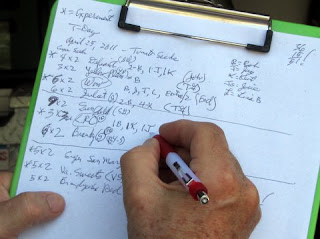
Notes are better than memory--at least for me
Step 5, Making Notes: The pen, paper, and clipboard are essential. After I’ve decided how many cups of each I’m starting, I make notes as I add the seeds of each variety, including an abbreviation for each variety. “By-R,” for example, means “Brandywine Red.” The last note on my list—“5x2 Brandywine Red (By-R)”—means I’m starting five cups, 2 seeds each, of that variety. Why two seeds? That’s the minimum. Sometimes three drop in. Germination rates of tomato seeds are high. Johnny’s Selected Seeds packets say their rate is 80%. So two seeds should get me 1.6 plants on average, but in reality, both seeds in most cups will sprout.
 
I'll know this plant is a Sungold
Step 6, Marking the Cups: Every time I finish dropping the seeds for a variety, I stop and make a note on the paper and then use the black felt-tip pen to write the abbreviation for that variety on the side of the cups holding that variety. There’s nothing worse than having several varieties of plants and not being able to identify them when it’s time to transplant them into your garden or give them to friends.

Step 7, Watering: After seeds are in their cups, I water them gently with a home-made plastic watering bottle—a water or soda bottle works well—that has a small hole in its cap. I make the hole by heating the tip of an awl on our electric stove and pressing it through the plastic cap. I gently squeeze the bottle to regulate the water flow just the way I want it. This year I used Miracle-Gro Seed Starting Mix, which is slightly moist to the touch, so I didn’t have to add much water—just enough to help the seeds sprout. Some mixes are dry and must be wetted down first—a messy pain in the bucket to my way of thinking.

Step 8, Covering Seeds: I use the tablespoon to cover the seeds with starting mix. Trial and error led me to the tablespoon. A rounded spoonful of mix covers the seeds in each cup “just right,” about a quarter of an inch.

Home-made watering bottle
Step 9, Watering 2: After the seeds are covered with mix, I gently water each cup again. The drainage holes in the bottom of the cups let me know when I’ve watered more than enough. I’ll check the cups daily until the seeds sprout and give them a little more water if the top of the mix looks too dry. When it dries, the color of the mix turns to light brown from dark brown.

Step 10, To the Utility Room: At first opportunity I move the trays of cups to our utility room, where I place them on a growing stand that friends recycled to me. The temperature there is about 73, just a degree or two below optimum temperature for tomato seeds to sprout. I’ll check the cups daily, and when the seeds sprout in five to seven days, I’ll turn on the lights.

T-Day: I’ve planted my tomato seeds. From time to time I’ll post about what’s happening in my TomatoPatch.

Wednesday, April 20, 2011

Rain, Rain, Rain: I Surrender

Rain, rain, go away...


April showers may bring May flowers, but, quite frankly, they’ve washed out my gardening plans.


I had every intention of planting cool weather veggie seeds—lettuce, beets, chard, carrots—during the first few days of April, but rain and showers saturated our garden and made that impossible. One day I started to hoe some winter weeds but surrendered—quite happily—when the sticky soil just wouldn’t fall off the roots of the weeds. Our Maryland soil is basically clay, so if I plant seeds in the wet soil, the soil will crust when it dries and the seeds may find it impossible to break through.


For every day of sun that we’ve had during the first three weeks of April, we’ve had two or three cloudy days, often with showers, rain, even downpours. The “Official weather data” for Baltimore-Washington International Airport through last evening, as reported in the Washington Post, tells the story: we’re nearly an inch above average rainfall year to date. The forecasts for the next five days aren’t encouraging for seed planting either: rain Tuesday, thunderstorm Wednesday, rain possible on Friday.


I surrender. If I can’t plant lettuce outside, I’ll plant it inside. And that’s exactly what I did late Monday afternoon.


I gathered essentials for starting plants inside: sterile starting mix (soil), beverage cups that I saved over winter, and, of course, seeds. I took the packets of lettuce seeds—Red Sails (Botanical Interests), Coastal Star (Johnny’s Selected Seeds), and Simpsons Curled (Bentley Seeds)—out of the plastic jar in which I store them in our refrigerator and went to work.


Plastic strips divide cup
First, with a Phillips screwdriver I punched two drainage holes in the bottom of each of the seven recycled cups I planned to use. Then I filled the cups three-quarters full of starting mix, dividing the growing area in half with plastic strips I fashioned with scissors from a blueberry box that I liberated from our recycling bin. (The plastic strips will make it easy to separate the plants, two per cup after thinning, when I transplant them later.) Then I sprinkled two or three seeds into each side, covered them with about a quarter-inch of starting soil, dampened them with water, and took the cups in a plastic tray into our kitchen, where they’ll sprout in five to 10 days in temperatures ranging from the 60s at night to 70s during the day.


I don’t plan to move the seedlings down to our basement utility room to grow for three or four weeks under fluorescent lights. Instead, when they sprout, I’ll carry them outside during daylight hours for a week or so, until they look tall enough to survive the next shower or downpour. Even though temperatures outside dip into the 40s at night, lettuce is a “cool weather” veggie that should be flourishing outside in our garden, not inside our house.


Why do I plant the lettuce varieties that I do?


Red Sails has beautiful, burgundy-tinged leaves that look and taste great in salads, and it’s slow to bolt when hot weather arrives, so we can harvest it longer into the summer. When lettuces bolt, they send up a flower stalk, turn bitter, and go to seed. From planting seeds to harvest: 45 days.


I bought Coastal Star as an experiment while looking in the Johnny’s catalog for Parris Island romaine. I liked what I read. It’s heat tolerant (slow to bolt), and similar to Parris Island but with darker green leaves. From planting seeds: 57 days.


I didn’t buy the Simpsons Curled seeds. They came in a promotional packet from an organization soliciting my membership. I’ve grown greenleaf Black Seeded Simpson, apparently a similar variety, for years. Small plants can be pulled to highlight salads in about 28 days and full-size plants will be ready in about 46 days.


Which variety will sprout first? Most likely the Simpsons Curled.


And I’m still wondering when we will get a week or 10 days, rain free, so I can plant carrot, beet, and chard seeds in our garden.

Friday, April 8, 2011

How Large a Rake Do You Need?

My heirloom rake gets the job done


Do I need a Tacoma pickup truck or an 18-wheeler to cart bags of pine-bark mulch from Sun Nurseries to our house?


Easy answer: My little Tacoma is just the right size, thank you, to haul about a dozen large bags. An 18-wheeler would be overkill—and the 90° bend in our narrow driveway would give fits to even a skilled big-rig driver.


And out in my garden, what size rake do I need for our flower and veggie gardens?


In her “A Cook’s Garden” column in the Washington Post, Barbara Damrosch shows a 29”-wide rake available from Johnny’s Selected Seeds, one of my favorite catalog and online sites. I looked up the rake in the catalog, and wow, the rake must be the Lexus of rakes.


Called the Bed Preparation Rake, its Swiss-made aluminum head is 29” wide. The head, which has 20 four-inch teeth, is adjustable, to suit your height or the job at hand. There’s even one optional accessory: a pack of six plastic tubes that slip onto the teeth of the rake to mark rows or make a grid. Total: $76.00 for the rake and $4.95 for the tubes, plus $11.95 shipping.


If you have a huge garden, hire hands to care for your garden, or grow neurotic carrots or beets that require straight planting rows for their seed, then this $90 rake is probably just what you need. But do Susie Smith and John Doe gardeners, with their 15x15 veggie beds, need such a large and expensive tool?


This gardener doesn’t. Like most gardeners, I have an old garden rake in the garage. It was my dad’s. The head is standard width, 14”, plenty wide for raking jobs in my small, terraced veggie beds. No, its 14 teeth are not adjustable, but I simply raise or lower the handle to change the angle of the teeth whenever I wish. It works fine the two or three times a year I need a rake.


Low-priced row marker
Can I get along without having plastic tubes to put on my rake teeth to mark rows for crop planting? Well, yes, in ancient times my dad showed me how the rounded handle end of the rake makes a dandy tool to make a row in garden soil. A corner of a hoe blade works just as well. My veggies grow well even if their rows zig a little or zag a little.


This frugal gardener will make do with his heirloom rake, which has served two generations well even though it doesn’t have adjustable teeth.


To read Damrosch’s article and see her photo of the big rake, CLICK HERE.

Monday, March 14, 2011

Indian Corn: More than Ornamental?


Indian corn, often called “ornamental” corn, with its bright blue, red, yellow, and white colors, makes beautiful autumn decorations. In her “A Cook’s Garden” column in the Washington Post, Barbara Damrosch tells why she thinks it’s more important than a rustic decoration to hang on your front door.


To read the Damrosch column, CLICK HERE.

Tuesday, March 8, 2011

Want to Start Garden Seeds Inside?

Tomato seedlings


Have you been thinking about getting a head start on summer 2011 gardening by starting veggie, herb, or flower seeds inside?


The University of Maryland Extension’s Grow It Eat It (GIEI) program has just posted how-to-do-it information to help you: a series of five articles and five videos.


The text series is called “Starting Seeds Indoors.” The five parts are: (1) Getting Started; (2) Containers and Growing Medium; (3) Plant the Seeds of Your Success; (4) Transplant Care; and (5) Hardening—Getting Transplants Ready for Outdoors.


The video series features Kent Phillips, a Howard County Master Gardener, who shows how he starts seeds under lights in his basement. The five parts (with time) are: (1) Timeline (2:06); (2) Materials (3:34); (3) Planting (4:53); (4) Care of Seedlings (2:45); and (5) Transplanting (2:27).


If you are a first-time seed starter, I recommend you read the text series and then look at the video series. The text will give you more comprehensive basic information, and the videos will show you how to put that information to work growing plants for your summer garden.


I’ll post a link to the GIEI website at the end of this posting. For the print series, when you get to the GIEI home page, look for the “Grow It” section at the top of the left column. Click on “Starting Seeds Indoors,” and then you will be able to click on each posting in the series. For the video series, look for the second section of entries, “Get Resources,” in the left column, and click on “Videos.” The seed-starting series tops the list.


Ready to start? To go to the GIEI website, CLICK HERE.

Tuesday, February 15, 2011

Why I Ordered the Seeds that I Did


I’ve made my “big” seed order online this year, with Johnny’s Selected Seeds.    I ordered six packets of vegetable and one of flower seeds.  Let’ me tell you why I ordered what I did.

Plato zucchini, $2.95 (average 30 seeds).  What’s a veggie garden without zucchini?  I usually pick a cheap packet off a rack in a big box store, but it was so easy to stop and browse in Johnny’s catalog.  Highlighted names in this catalog are called “Easy Choice” selections that are easy to grow, widely adaptable, and good tasting.  A plus is that Plato has excellent disease resistance, which may prevent problems if this summer is extra hot and humid.

Diva seedless and thin-skinned cucumber, $2.95 (20 seeds).   Johnny’s says Diva “just might be the best-tasting cuke on the planet.”  Hmm, “just might,” but then, maybe not.  Quite frankly, I’ll settle for a good-tasting cuke in my garden and will let the planet fend for itself.  Since powdery mildew wiped out my cukes last summer, I was attracted to Diva because it’s resistant to mildews and scab.  The fruit is “bitter-free,” which also is a plus.  And for those who never read anything without their Funk & Wagnall’s Dictionary by their side, this cuke variety is gynoecious and parthenocarpic.

Ok, I surrender.  “Gynoecious” means the plants are all-female, which most likely makes that part of the cuke universe interesting indeed.  “Parthenocarpic” means it can grow fruit without pollination.  Just what is Mother Nature up to these days?   I rush on and refuse to speculate.

Coastal Star lettuce, $2.95 (600 seeds).  For several years I’ve grown Parris Island Cos/Romaine, a lovely upright, green lettuce that does well even in our mid-Atlantic heat.  Johnny’s has Parris Island, but I noted Coastal Star just above it with this note: “Similar to Parris Island but … darker green and more tolerant to heat.  Since I usually plant early and late crops of lettuce so it can flourish in the cooler spring and fall weather, I thought I’d try Coastal Star for just a little more heat tolerance.  Lettuce bolts (grows a flower stalk) and turns bitter in hot weather.  Maybe Coastal Star will extend my lettuce season.

Sun Gold, our favorite tangerine-orange cherry tomato, $2.95 (40 seeds).  I don’t think I’d plant tomatoes if I couldn’t grow some Sun Golds.  They’re vigorous, long-bearing indeterminate plants.  You may find Sun Golds available at a farmer’s stand near you, but they tend to split, especially after rain, so the best place to find them is in your backyard garden.  They have one serious downside, though.  If you pick a bowl of them, by the time you get the bowl to your kitchen, it will be half empty.

A determinate tomato variety is one that continues to grow, bloom, and fruit until frost or disease kills the plant, so there is a continuing series of fruits growing and maturing during the growing season.  An indeterminate variety tops off at a specific height and tends to bear fruit over a relatively short time period.  Determinate varieties do well in containers or in small garden spaces.

Defiant PhR tomato, $4.95 (20 seeds).  Every year I try out a new tomato or two, and this is one for this year.  Several seed companies have new varieties advertised as resistant to late blight, but Johnny’s says this one, developed in cooperation with North Carolina State University, has “high resistance to late blight and intermediate resistance to early blight combined with great taste.”  Late blight devastated tomato crops in many areas of the country in 2009.  Early blight is a minor bother endemic to my garden, so I’m going to give Defiant a try.  The “PhR” in its name refers to its Resistance to Phytophthora, the water mold that causes late blight.  Defiant is a determinate variety, so I will be eager to see if it produces well and for how long.

Helenor rutabaga, $2.95 (300 seeds).  It’s an embarrassment that at our local Giant Food store the checkout clerks generally don’t know a rutabaga from a football and the store’s veggie chart lists them under “Yellow Turnip.”  Clearly this is a veggie that gets no respect.  But I love rutabagas!  We cannot have Thanksgiving dinner without a bowl of rutabagas—simply boiled and mashed with butter or with cream.  Oh, why do I salivate as I type this?

Love-Lies-Bleeding amaranthus, $2.95 (100 seeds).  I have a soft spot for beautiful flowers.  For several years I’ve grown Cock’s Comb celosia, which in late summer has a dark, red comb like a rooster that all but invites you to cut and dry it for winter display on your desk or mantle.  I usually start a half dozen to 10 plants, put two in my garden and give the rest away.  I recently asked Linda, who enjoyed a gift Cock’s Comb last year, if I should repeat or try something new, like Love-Lies-Bleeding, which features deep red, trailing chenille-like blooms.  She said they’re both beautiful, would complement each other, and suggested I start some of each.  Since I have extra Cock’s Comb seeds from last year in the seed jar in our fridge, I quickly agreed.

Five packets, $23.65 plus $6.95 shipping—reasonable price, unlimited summer exercise and delight.  Yes, Grow It Eat It, but I’ll pass on the Love-Lies-Bleeding.

If you’d like to see what these varieties look like, you can see good photos in Johnny’s catalog.  To go there, CLICK HERE.

Thursday, February 10, 2011

Veggie, Flower, Herb Seeds Have Arrived!


Who could be happier on a gray, 33°F February day than a gardener standing before just-assembled Burpee seed racks at a local store? Forget Pauxatauny Phil and his shadow. Burpee seeds are here—ready for you to buy! Spring is coming to a garden near you soon!


Yes, seed racks for 2011 are ready for your perusal in many local stores. The snow crust on your lawn may encourage you to stay close to the glowing embers in your fireplace, but don’t linger too long. If you wait until April or May to buy, you may be disappointed at the selection remaining. I’ve been there, done that.


I was pleasantly surprised at the size of the new Burpee display when I stopped by Wal-Mart this morning. I did a rough estimate: more than 400 pockets of seed packets; 60% veggies, about half organic; 25% flowers, both annual and perennial; 15% herbs, both annual and perennial.


Being a tomato fanatic, I usually rate seed racks by the number of tomato varieties offered. The Burpee racks at this store offer: Baxter’s Bush Cherry, Beefsteak and Super Beefsteak, pink and red Brandywine, Cherokee Purple, Delicious, Lunch Mate, Polish Linguisa, Red Lightning, Roma, Snack Attack, Summer Salsa, Super Sweet 100, Yellow Pear, and two mixes—Best of Show and Rainbow Heirlooms. That’s nearly double the varieties offered last year.


Price: about half the packets are $1.00 each, the other half $1.50, including most of the organic selections.


What did I buy?


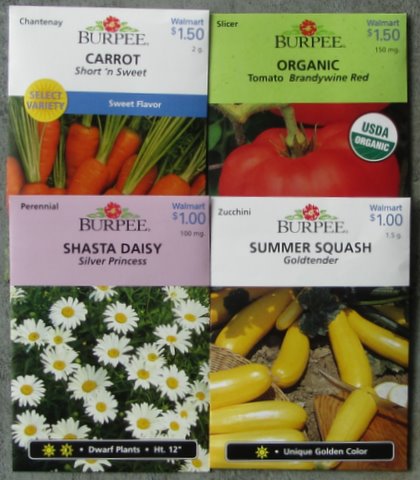
Brandywine red tomato (organic), $1.50; Goldtender summer squash ($1.00); Short ‘n Sweet carrot, $1.50; Cylindra beet, $1.00; Detroit Dark Red beet (organic), $1.50; and Silver Princess Shasta daisy (perennial), $1.00, a short “pretty” that the deer won’t eat.


That’s all? Well, yes, that’s all I bought at Wal-Mart. The section was excellent for a big-box store but didn’t have all that I’m looking for. Within the next day or two I’ll finalize my online order from Johnny’s Selected Seeds, and I’ll be pretty much set for seeds for Garden Year 2011.


Is there a difference between a packet of veggie seeds bought from the Burpee catalog and a packet bought from a Burpee rack at a local store?


Yes, an obvious difference is price. A packet of Detroit Dark Red beet seeds in the Burpee catalog (and online) costs $3.25, while the packet from the Burpee rack at Wal-Mart costs $1.50. Burpee prices seem to vary from store to store.


Surprise: 469!
I’ve always suspected another difference is the amount of seeds in the packets. The number of seeds in the Burpee catalog beet packet is 350. The Burpee packet at Wal-Mart says 5g, with no number of seeds indicated. Frugal Bob opened and counted each seed, expecting the number to be significantly less than 350. The number: 469. I admit that I was surprised, pleasantly surprised. I had always assumed there were fewer seeds in the lower-priced packet.


Not totally convinced, I went to Burpee online and priced a packet of red Brandywine tomato seeds (organic): $3.95 for 50 seeds. I opened and counted the packet I bought at Wal-Mart, which indicated 150mg. The count: 66 seeds.

 
Ok, I surrender. The lower-priced Burpee packets at Wal-Mart contain just as many seeds, if not more, than their more expensive catalog counterparts. Could Burpee be using inferior seed in the lower-priced packets? Burpee’s name is both famous and trusted in the world of gardeners, so it would be business suicide, it seems to me, for the company to sell seeds of lesser quality in a packet labeled Burpee.


There is another difference I’ve noticed between seed varieties on the racks and those in the catalog. The varieties on the racks seem to be older, better known varieties. The catalog lists many of them too but often features the newest and latest varieties, which may—or may not—be better in some ways than older varieties.


I’ll mention one risk in buying all your Burpee seeds at a neighborhood store. You may eventually be dropped from the Burpee catalog mailing list, though I suspect the trend for most seed companies is to wean their buyers from print to Internet catalogs to help keep down costs.


Now I’ve got to finalize my order for Johnny’s.

Wednesday, February 9, 2011

Totally Tomatoes Isn't Totally


Totally Tomatoes doesn’t sell only tomato seeds. I suppose the company was named when it sold only tomato seeds—but over the years its product lines have expanded to peppers (sweet, hot, & ornamental), cucumbers, and a smattering of other veggies, such as lettuce, cauliflower, squash, carrots, watermelons, and cantaloupes.


To give an idea of company offerings, the 60-page catalog devotes 25 pages to tomato seeds, 14 pages to pepper seeds, two pages to cucumbers, and about 10 pages to a mixture of the above or other veggies. Most packets contain 20 or 30 seeds.


The catalog contains a two-page article under the headline, “These Simple Steps Yield Totally Terrific Tomatoes” that should move any student of tomato growing to the head of her class. Subsections include “Seeding,” “Growing On,” “Hardening Off,” “Site Preparation,” “Transplanting,” “Culture,” “Diseases & Pests,” “Container Gardening,” and “Preserving.”


For tomatoes, variety names are followed by “disease resistance” abbreviations, such as Celebrity Hybrid VFFNTASt. Abbreviations are explained in the “Simple Steps” outline. Variety descriptions include days to maturity, factual highlights, and whether the variety is determinate or indeterminate.


Cucumber descriptions also indicate disease resistance, with five varieties labeled as resistant to downy and powdery mildew and others indicating “excellent disease resistance” or similar characteristics.


The company website contains convenient tabs to help find what you’re looking for: New, Tomato Seeds, Pepper Seeds, Tomato & Pepper Plants, and Other Vegetable Seeds. For a free catalog, click the “Get Catalog” tab at the top of the home page.


Price of a sample seed order: Packet (30 seeds), Big Beef Hybrid VFFNTASt tomato, $2.55. Packet (20), Juliet Hybrid tomato, $2.35. Packet (25), King Arthur Hybrid pepper, $2.85. Shipping: $4.95. Total: $12.70.


CLICK HERE to link to the Totally Tomatoes website.